
Some parts are too small, too delicate or too numerous to take onto an open blasting site. A blast cabinet brings that work indoors: the part sits in a sealed chamber, the operator blasts it through glove ports while watching through a viewing window, and the abrasive falls back into the system to be used again. You get a controlled, repeatable finish, a clean workshop around the machine, and media that lasts many passes instead of one.
Blast cabinets are where Storm Machinery began. Our founder, Peter De Rouwe, started the business in Pinetown, Durban in 1989, and the first Storm cabinet was assembled in 1990 (read our story). Our suction and pressure cabinets are still built in-house in Boksburg, and backed by the team that supplies them, with spares on the shelf at our Johannesburg, Durban and Cape Town branches.

BROWSE OUR BLAST CABINET CATEGORIES
OUR BLAST CABINETS


What Is A Blast Cabinet?
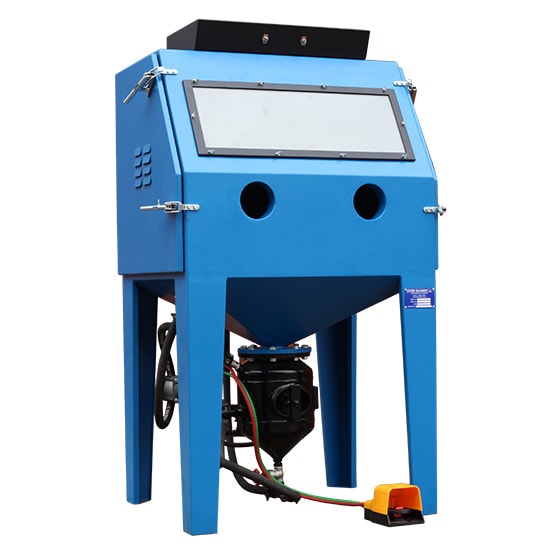
A blast cabinet is an enclosed abrasive blasting machine that recirculates its own media. Compressed air drives abrasive out of a hand-held gun inside a sealed chamber; the spent media drops through the floor grate into a hopper and returns to feed the gun, while a dust extractor pulls the fine dust out so the operator can see the work. Cabinets differ mainly in how the abrasive reaches the nozzle, by suction or by pressure, which the buyer’s guide below covers.
Size The Air Supply Before You Size The Cabinet
Most buyers compare blast cabinets by the size of the chamber. The figure that decides how a cabinet performs in your workshop is how much compressed air it uses, and across our range that varies far more than the footprint does.
At 6 bar, the SM800S suction cabinet uses 18 CFM (500 L/min) and the SM1000S uses 28 CFM (785 L/min). The SM1000/P20 pressure cabinet shares the SM1000S’s 1000 × 850 mm footprint but needs 84 CFM (2,350 L/min): three times the air for the same floor space.
That extra air is what buys the pressure cabinet its speed. We rate the SM1000/P20 at 8 to 10 times faster than a traditional suction cabinet, but only when the compressor keeps up. An undersized supply shows up as a weaker blast and longer cycle times rather than an obvious fault, so check what your compressor delivers, and what else runs off the same line, before choosing between suction and pressure. Our guide to compressor sizing for sandblasting covers the wider picture.
Designed And Built By Storm Since 1990
- The product we started with. Blast cabinets were the first equipment Storm designed and manufactured, and more than three decades of workshop feedback have shaped the current range. Every cabinet is still welded and assembled by our own team.
- Built for wear and visibility. The SM1000/P20’s interior is urethane-lined, and a stainless steel mesh gives its viewing glass extra protection. LED tubes light the chamber in every cabinet.
- Certified pressure vessel. The SM1000/P20’s 20 L vessel, worked by a stop/start foot pedal, is a modified blast pot. It conforms to the same standards as our blast pots and is supplied with a pressure test certificate.
- Matched dust extraction. Each cabinet is designed to pair with one of our free-standing, heavy-duty extractors, fitted with cartridge filters and a built-in vibrator that shakes them clean.
- Serviced by the people who build it. Every cabinet we supply is serviced and repaired by our own technicians.
- Operator training. OEM training is available on equipment bought through Storm, including our Basic Principles of Abrasive Blasting sessions.
Buyers Guide - Matching A Cabinet To Your Parts And Finish
Suction Cabinets
For cleaning, etching and finishing on brass, aluminium, glass and other surfaces that need a light touch, our suction cabinets are the natural choice. Air passing through the gun creates a vacuum that draws abrasive up from the hopper, which keeps the blast gentle and the air demand low. Typical jobs include mould cleaning, etching, frosting, engraving, polishing and preparing parts for crack detection. The system is designed to run a wide range of media, from glass beads and garnet to aluminium oxide, slags, organic abrasives and plastic media.
There are two sizes. The compact SM800S (710 mm internal height, Standard Gun with a 6 mm nozzle) suits smaller components, while the SM1000S (860 mm internal height, Major Gun with an 8 mm nozzle) gives larger parts more room. Both pair with our Single Extractor, sold separately.

Pressure Cabinets
For stripping heavy rust, mill scale and old coatings from steel components, our pressure cabinet, the SM1000/P20, brings blast pot pressure indoors. With the blasting sealed inside the cabinet, there’s no need for a dedicated blast yard or booth. A certified 20 L pressure vessel drives the media through the nozzle, which suits it to steel grit and steel shot (the vessel holds up to 50 kg) and to steel rusted to grades C and D.
Run steel grit when the part needs an anchor profile for coating; steel shot cleans and peens but doesn’t cut a profile. A turntable comes standard for turning heavier parts, and the cabinet pairs with our Double Extractor, sold separately. If you want to recover and reuse finer media such as glass beads, we can build a custom cyclone separator to sit between the cabinet and the extractor. Talk to our sales team first: abrasive breaks down slightly with every impact, so recycled media leaves a different finish to new media.
Cabinet Spares
Every cabinet has parts that wear with use. Our cabinet spares keep it running: replacement Standard, Major and Trigger guns, rubber gloves, filter bags, dust cartridges, fans and foot pedals.

Quick Reference: Which Blast Cabinet For Which Job
- Etching, frosting or engraving glass → Suction cabinet
- Cleaning moulds or preparing parts for crack detection → Suction cabinet
- Light cleaning or finishing on brass and aluminium → Suction cabinet
- Smaller components → SM800S suction cabinet
- Larger parts on a suction setup → SM1000S suction cabinet
- Heavy rust, mill scale or old coatings on steel parts → SM1000/P20 pressure cabinet
- Blasting with steel grit or steel shot → SM1000/P20 pressure cabinet, built for steel abrasives
- Steel parts that need an anchor profile for coating → SM1000/P20 with steel grit
- Heavy or awkward parts that need turning → SM1000/P20, turntable fitted as standard
- Parts too large for the chamber → An open blast pot setup instead
FAQs
Is a blast cabinet the same as a sandblasting cabinet?
Yes. Blast cabinet, sandblasting cabinet, sandblast cabinet and bead blast cabinet all describe the same enclosed, media-recycling machine. The “sand” is a leftover from when silica sand was the usual abrasive, which it no longer is. A blast room is different: a walk-in enclosure for large items such as vehicles. So is a shot blasting machine, which throws steel shot with a spinning wheel rather than compressed air. Our range covers blast cabinets, not blast rooms or wheel machines.
Is a vapour blasting cabinet the same as a blast cabinet?
Not quite. In a vapour blasting cabinet the abrasive is mixed with water and fired as a slurry, which keeps dust down inside the chamber; you’ll also see the process called wet blasting or vapour honing. Our cabinets are dry blast cabinets: the media is fired dry and a dust extractor clears the air. If you need water-based dust control on open steelwork, our dustless blast pots bring water into the blast instead.
What's the difference between a suction and a pressure blast cabinet?
It comes down to how the media is fed: drawn by vacuum in a suction cabinet, pushed from a pressurised vessel in a pressure cabinet. Suction suits finishing and lighter cleaning; pressure suits fast, heavy removal on steel.
Which abrasives can I use in a blast cabinet?
A silica-free abrasive that holds up to being recovered and fired again. Suction cabinets take lighter media such as glass beads, while the pressure cabinet is built for steel grit and shot. From our own range, Glass Beads are the natural cabinet media.
Do I need a dust extractor with a blast cabinet?
Technically no, but in practice yes. The extractor draws fine dust out of the chamber so the window stays clear and dust stays out of your workshop. Without one, the dust inside the chamber soon gets too thick to see the part. Our extractors are sold separately: suction cabinets pair with the four-cartridge Single Extractor, and the SM1000/P20 with the eight-cartridge Double Extractor. You can also connect a suitable extractor you already own.
What size parts fit in a blast cabinet?
Anything that fits through the doors and can be turned inside the chamber. Internal height is 710 mm in the SM800S, 860 mm in the SM1000S and 800 mm in the SM1000/P20, measured including its turntable. Each cabinet has two doors for loading.
Does the pressure cabinet need pressure testing?
Yes. Its 20 L vessel is a pressure vessel, so beyond the certificate it ships with, it needs in-service inspection and testing at set intervals, just like a blast pot. The commonly cited interval is at least every 36 months, and most mines ask for a test every year, but your project specification, insurer or inspector may require something different. We test cabinet vessels at our Boksburg branch: see our pressure testing service to book.
How do I keep a blast cabinet working well?
Check the wear parts regularly: gloves for tears, the viewing glass for frosting, the gun nozzle for wear and the filter cartridges for build-up. Top up or replace media as it breaks down to dust, because worn-out abrasive cuts slowly and clouds the chamber. How often depends on how many hours the cabinet runs and the abrasive you use. Replacement parts are in our cabinet spares range.
Do you service and repair blast cabinets?
Yes, for cabinets supplied by Storm. Bring it to our Johannesburg, Durban or Cape Town branch: our technicians handle everything from the blast gun to the extraction, and most cabinet repairs are back with you in two to three working days, depending on what’s wrong and the parts it needs. Book through our Equipment Repairs & Servicing page.
Complete Your Setup
A cabinet sits at the centre of a workshop routine: the media you load into it, the air you feed it and the jobs that outgrow it.
What Goes Round - Abrasives
Not every abrasive survives a cabinet’s constant loop. Browse our silica-free abrasives, each with a downloadable data sheet, to pick one that holds its shape.
Dry Air In - Air Treatment
Moisture from the compressor makes abrasive clump in the hopper and stutter at the gun. Our air treatment units, from water traps to after coolers, take it out before it reaches the gun.
When The Part Won't Fit — Blast Pots
When a job outgrows the chamber, open blasting takes over: a dry or dustless blast pot handles structural steel, tanks and other large work.
Not sure whether your parts call for suction or pressure? Tell our team what you’re blasting and the finish you need, and we’ll point you to the right cabinet.