
Adhesion testing tells you the one thing a thickness gauge or a profile reading can’t: whether the coating is actually going to stay put. A film can be applied at the right thickness, over a perfectly profiled surface, and still fail early if the bond to the substrate — or between coats — was never sound to begin with. Pull-off and cross-hatch testing give inspectors a quantifiable, standards-based answer before that failure shows up on-site, months into a project, as blistering or delamination.
As the South African representative for DeFelsko, Storm Machinery supplies, services and calibrates the full PosiTest adhesion testing range through our own authorised repair centre.
OUR INSPECTION EQUIPMENT
Showing all 3 resultsSorted by popularity

Why the Correct Technique Matters
An adhesion test is only as reliable as the pull itself. If the force isn’t applied dead-square to the surface, the reading skews – a phenomenon inspectors call “peeling,” where an uneven pull registers a lower bond strength than the coating actually has. DeFelsko’s PosiTest AT range addresses this with a self-aligning dolly head that distributes load evenly across the test area regardless of small surface irregularities, so the number on the screen reflects the coating, not the technique.
Just as important is what happens after the pull. Standards like ASTM D4541 and ISO 4624 don’t just ask for a pressure reading – the inspector also has to look at where the coating actually let go. A split within the coating film itself points to a problem with the coating; a clean break at the substrate interface points back to surface prep instead; and if the test glue itself gives way rather than the coating, the reading isn’t valid and the pull needs repeating. For a QC report, that description of how it failed is often more useful than the pull-off number on its own.
Standards and Calibration Traceability
Storm’s DeFelsko adhesion testing range conforms to:
- Pull-off testing (PosiTest AT): ASTM D4541, ASTM D7234, ASTM D7522, ASTM C1583, ASTM C1857, ISO 4624, ISO 16276-1, EN 1542, EN 12004-2, AS/NZS 1580.408.5
- Cross-hatch testing (PosiTest CH): ISO 2409, ISO 16276-2, ASTM D3359, AS 3894.9/1580.408.4, JIS K 5600-5-6
Every PosiTest adhesion tester ships with a calibration certificate traceable to NIST.
Buyer's Guide - Choosing the Right Adhesion Tester
PosiTest AT-A (Automatic Pull-Off)
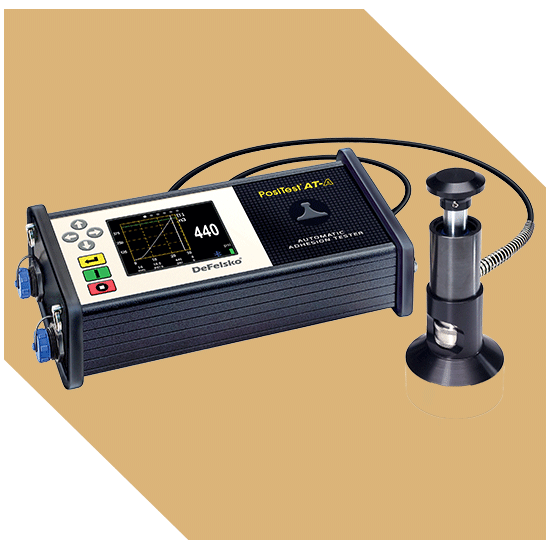
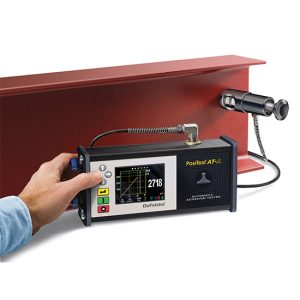
For inspectors running high volumes of tests or needing a full audit trail, the PosiTest AT-A applies pull-off pressure electronically at a user-set rate, removing operator variability from the result. It stores pressure-vs-time data, pass/fail status and fracture type for up to 100,000 pulls, syncing via USB to PosiSoft Desktop – useful where a client expects a formal, traceable dataset rather than a handwritten logbook.
PosiTest AT-M (Manual Pull-Off)
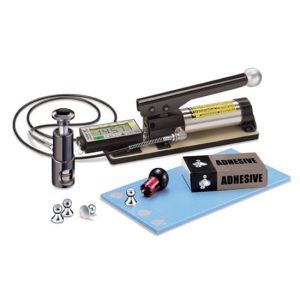
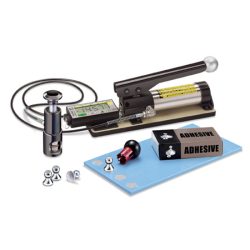
Where full automatic data logging isn’t the priority, the PosiTest AT-M delivers the same self-aligning, standards-compliant pull-off test, built around a hand-operated hydraulic actuator rather than the AT-A’s electronic pump. It still stores each result to internal memory – up to 200 pulls – and connects via USB to PosiSoft Desktop for reporting, just without the AT-A’s higher capacity, automatic pass/fail, or fracture-type logging. A built-in pull-rate indicator helps the operator keep the pull consistent by hand.
PosiTest CH (Cross-Hatch)
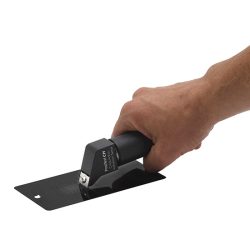
Reach for the PosiTest CH when the spec calls for a fast go/no-go rating rather than a measured pull-off value – it’s the quicker, lower-cost route to a coating adhesion check on thinner films, and doesn’t require the glue cure time a pull-off test does. Full blade and standard options are on the product page.
Quick Reference: Which Adhesion Tester for Which Job
- High bond-strength coatings on steel (structural, marine, pipeline) → PosiTest AT-A or AT-M, 20 mm dolly
- Lower bond-strength coatings on concrete, wood or plastic → PosiTest AT-A or AT-M, 50 mm dolly
- Concrete surfaces and overlays to ASTM C1583 → PosiTest AT-A50C / AT-M50C
- Tile adhesive systems to EN 12004-2 → PosiTest AT-A50T / AT-M50T
- Thin coatings, quick QC pass/fail, no destructive plug removal → PosiTest CH cross-hatch
- High test volumes, full digital reporting, multiple inspectors on one project → PosiTest AT-A (automatic)
- Site jobs, tighter budget, occasional readings rather than high-volume logging → PosiTest AT-M (manual)
FAQs
What's the difference between pull-off and cross-hatch adhesion testing?
Pull-off testing (PosiTest AT) gives you a numerical bond-strength value in MPa or psi by pulling a glued dolly off the coated surface. Cross-hatch testing (PosiTest CH) is a faster, qualitative pass/fail method – a lattice is cut into the coating and assessed visually against a ratings scale. Neither replaces the other; pull-off is used where a specification calls for a measured value, cross-hatch where a quick go/no-go check is enough.
Is adhesion testing a destructive test?
Yes. Both pull-off and cross-hatch methods remove or damage a small area of the coating to get a result, which is why test locations are usually chosen carefully and touched up afterwards.
What do "cohesive," "adhesive," and "glue" failure mean on a test report?
A cohesive failure means the coating split within its own film. An adhesive failure means it let go at the interface with the substrate or another coat – usually the more serious finding. A glue failure means the test adhesive itself failed rather than the coating, which invalidates that specific reading and means the test should be repeated.
What's the minimum substrate thickness for pull-off testing?
There’s no manufacturer-specified minimum here – DeFelsko leaves that call to the user, since it comes down to how rigid the substrate is under the pull force being applied. If a substrate is thin enough to flex during the test, backing or clamping it removes that risk before it skews the result. Your project specification is the right place to look for a hard number if your job calls for one.
Can adhesion testing be done on curved surfaces?
Curved surfaces are testable, but the dolly needs to sit flat enough on the surface for an even pull. As a rule of thumb, a standard dolly handles pipe or tank diameters down to about 200 mm; below that, switching to the 10 mm or 14 mm dolly extends the usable range down to roughly 100 mm and 50 mm respectively, depending on the coating’s expected bond strength. Past that point, the curvature introduces sideways loading the test isn’t built to measure, so most standards call for a flat test area instead.
How often should an adhesion tester be calibrated?
Most quality programmes call for annual verification against a certified reference, such as the PosiTest AT Calibrator, in addition to the factory calibration certificate supplied with the instrument. Exact intervals can vary by project specification or client QA requirements, so it’s worth checking the governing standard for your job rather than assuming a flat figure. As an authorised DeFelsko distributor and service centre, Storm Machinery carries out these calibrations locally, so instruments don’t need to be shipped overseas for routine servicing.
What standards does Storm's adhesion testing range conform to?
The PosiTest AT pull-off range conforms to ASTM D4541, D7234, D7522, C1583 and C1857, along with ISO 4624, ISO 16276-1, EN 1542, EN 12004-2 and AS/NZS 1580.408.5. The PosiTest CH cross-hatch range conforms to ISO 2409, ISO 16276-2, ASTM D3359, AS 3894.9/1580.408.4 and JIS K 5600-5-6.
Should I choose the manual or automatic PosiTest AT?
Both use the same self-aligning actuator and meet the same accuracy specification, so the choice comes down to workflow rather than precision. The AT-M suits straightforward site testing with a hand pump; the AT-A is worth the upgrade where you need automatic pull-rate control, digital batch logging, or PDF reporting for a client.
Can I store and download adhesion test readings?
Yes. Both the AT-A and AT-M save results to internal memory as you test – up to 200 pulls on the AT-M, up to 100,000 on the AT-A – and connect via USB to DeFelsko’s PosiSoft Desktop software for viewing, printing and reporting. The AT-A adds Bluetooth connectivity to the PosiTector App and PosiSoft.net, DeFelsko’s free cloud storage, for backing up and sharing data across a team.
Complete Each Project Stage
Adhesion testing only tells part of the story – what happens before it determines whether the result means anything at all. At Storm Machinery, we supply the equipment for every stage of that process, not just the tester that checks this one result.
Where It Starts - Surface Preparation
A poor adhesion result often traces back to the surface itself. Our surface profile gauges confirm the anchor pattern was right before the coating ever went on – usually the first thing worth checking when a pull-off test comes back low.
During Application - Environmental Monitoring
Temperature, humidity and dew point at the time of coating all affect how well it bonds. Our environmental monitoring equipment records those conditions, so you know whether the application itself played a part in an adhesion result.
Before You Test Adhesion - Coating Thickness
An over-applied film carries its own adhesion risk, quite apart from anything the surface prep did right. Check coating thickness readings alongside your adhesion results to rule that out.
Not sure whether adhesion testing is the right starting point for your inspection kit, or whether the issue sits upstream at surface prep or coating thickness? Get in touch and we’ll help you match the right instrument to your specification.