
A concrete slab can feel bone dry on top while the water from its pour is still trapped lower down. Seal it under an epoxy coating, vinyl, tiles or a glued timber floor before that moisture has gone, and it has nowhere left to escape. It collects under the new surface and comes back months later as blistered coatings, lifting tiles, failed adhesive or mould. Concrete moisture testing tells you whether the slab is ready before the floor goes down, so the decision rests on a measurement instead of the calendar.
Storm Machinery is the South African representative for DeFelsko, and we stock both of its concrete moisture instruments: the PosiTest CMM non-destructive meter for fast surveys, and the PosiTector CMM IS in-situ relative humidity probes for testing to ASTM F2170.

OUR INSPECTION EQUIPMENT
Showing all 2 resultsSorted by popularity


Moisture Content Or Relative Humidity: Which Number Does Your Spec Want?
“Concrete moisture” can mean several different measurements, and flooring and coating data sheets don’t all ask for the same one. Moisture content (MC) is the weight of water in the concrete as a percentage of its dry weight. Relative humidity (RH) is the humidity of the air held in the concrete’s pores, measured inside the slab itself. A third figure, the moisture vapour emission rate (MVER), measures how quickly moisture escapes from the surface, and comes from a separate calcium chloride test.
These numbers don’t convert neatly into one another, so start with the figure your specification quotes and choose the test that produces it. A limit of around 75% RH is often quoted for coatings and resilient flooring, but the acceptable figure varies from one product to the next, and the manufacturer’s data sheet has the final say.
Why A Dry Surface Doesn't Mean A Dry Slab
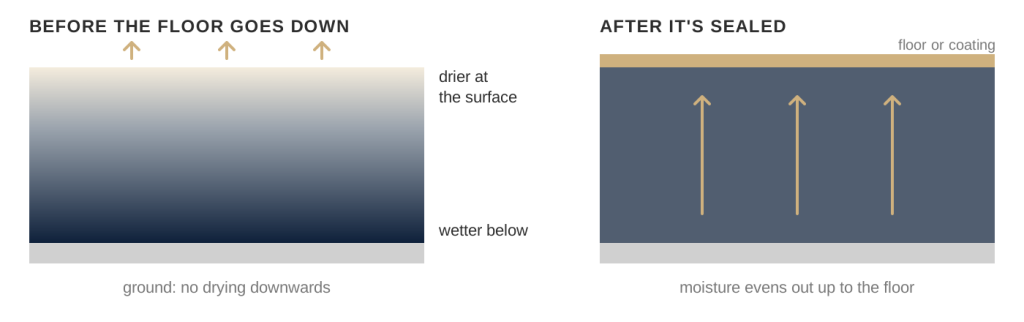
A slab cast on the ground can only dry through its top face, so it dries from the top down. Months after the pour, the upper few centimetres may be well within limits while the concrete beneath still holds far more water. A test that only looks at the surface sees the dry part and misses the rest.
That changes the moment the slab is covered. A coating or floor covering stops the drying, and the moisture lower down starts to spread back up until the whole depth evens out. The underside of the new floor ends up sitting in that evened-out humidity, not in the dry reading taken on the day. That’s why ASTM F2170 places its probe at a set fraction of the slab’s depth, with the two depths listed in the Quick Reference: research behind the standard found that point gives the best indication of what the floor will be exposed to once it’s sealed. A slab poured years ago isn’t automatically dry either. If the damp-proof membrane underneath was never laid or has been punctured, water from the ground can keep wicking up into the concrete long after the original pour has dried out.
The Test Methods Behind Every Reading
Both instruments are built around the ASTM methods that flooring and coating specifications quote for concrete slabs, so you can report a result against the method your specification names:
- ASTM F2170: relative humidity in concrete floor slabs measured with in-situ probes (PosiTector CMM IS)
- ASTM F2659: preliminary, comparative moisture evaluation of slabs and screeds with a non-destructive electronic meter (PosiTest CMM)
- ASTM E104: the saturated salt method behind the CMM IS calibration check chambers
Every CMM IS probe is certified individually, and its certificate lists the actual values it read against NIST-traceable references. The PosiTest CMM ships with a test certificate recording its readings on concrete blocks whose moisture content was established by weighing (the gravimetric method).
Buyer's Guide - Matching The Test To Your Slab
The two instruments answer different questions. One gives you a quick picture of where the slab is wetter or drier; the other gives you the documented humidity figure a specification can be signed off against. On many jobs they work best together.
PosiTest CMM
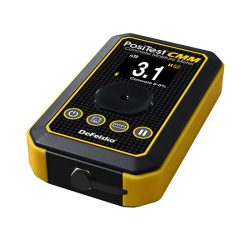
When you need a fast survey without drilling, the PosiTest CMM takes its reading through spring-loaded pins pressed against the slab. The meter looks about 20 mm into the concrete, and because its electrical (impedance) reading shifts with the amount of water present, it can show the result as moisture. You get that result in seconds on three scales: % moisture content (0-6%, calibrated against weighed samples), a calcium carbide method equivalent (0-4%), and a relative 0-100 scale for straight comparisons. In its hold-and-save mode the meter stores each result by itself once the number stops changing, it keeps 200 readings for PosiSoft Desktop reports, and its IP65 housing copes with dusty, wet sites. ASTM F2659 treats this kind of reading as a comparison, though, so it’s the right tool for mapping a slab and spotting problem areas rather than for signing one off.
PosiTector CMM IS
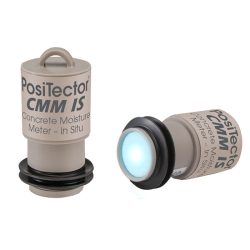
When the specification calls for ASTM F2170, the PosiTector CMM IS measures relative humidity and temperature from inside the slab. Once a 19 mm (¾”) hole is drilled to the standard’s depth, the probe goes in sensor-first and a cap seals it. The sleeve is built into the probe, so there are no single-use sleeves to buy, and each probe is reusable. A coin cell keeps it running for as long as three weeks, sending readings by Bluetooth to the free PosiTector App on a phone or tablet, so you never have to uncap the hole to check it. Drilling times, readings and probe positions all go into the app, which marks each probe on a photo of your floor plan and turns the job into a PDF report laid out for F2170. Probe accuracy is ±2% RH up to 90% RH and ±3% above that, and stackable extensions let the probe reach full depth in slabs thicker than about 100 mm.
A 300 m² floor, for example, needs five probes under F2170: three to cover the first 100 m², then one for each 100 m² after that, and at least one of the test points has to sit within a metre of every exterior wall. The kits follow the same arithmetic: a Basic Kit with three probes, a Complete Kit with five, and a Pro Kit that adds a PosiTector DPM Advanced gauge to the Complete Kit. Expansion packs of 1, 4 or 16 extra probes cover larger floors.
Using Both On One Slab
On a large floor, scan it with the PosiTest CMM first. The readings show where the slab is holding the most moisture, and you can place some of your CMM IS probes there, alongside the locations F2170 already requires. That way the drilled tests cover the parts of the floor most likely to fail.
Quick Reference: Which Concrete Moisture Test For Which Job
- Specification calls for ASTM F2170 or an in-slab RH figure → PosiTector CMM IS only
- Quick survey of a slab, no drilling allowed → PosiTest CMM
- Specification quotes % moisture content or a carbide-method figure → PosiTest CMM (confirm your spec accepts a meter reading)
- Large floor, need to decide where to drill → PosiTest CMM to map it, then PosiTector CMM IS probes at the wettest spots and the required locations
- Slab on the ground, drying from the top only → drill to 40% of the slab’s thickness
- Suspended slab, drying from top and bottom → drill to 20% of the slab’s thickness
FAQs
Is a concrete moisture meter the same as an ordinary moisture meter or a hygrometer?
Not quite. “Concrete moisture meter”, “concrete moisture tester” and “slab moisture meter” usually mean an instrument made for concrete, such as the PosiTest CMM, while “concrete RH meter” or “in-situ RH probe” points to the drilled-hole method used by the PosiTector CMM IS. A general-purpose pin moisture meter is designed mainly for timber and other building materials and isn’t calibrated for concrete. A hygrometer measures the humidity of the air in the room rather than inside the slab. That job belongs to the dew point meters in our environmental monitoring range.
Can either instrument do the calcium chloride test?
No. That test (ASTM F1869) reports a moisture vapour emission rate (MVER): a dish of calcium chloride is sealed under a dome on the slab for a set time, and the weight it gains shows how much moisture came out. Because it samples only the uppermost layer, and responds to the air in the room as much as to the concrete, more and more flooring specifications now ask for in-situ RH testing to ASTM F2170 instead. If yours still names F1869, you’ll need to run it as a separate test.
Does the room need to be ready before I test?
Yes, for both methods. ASTM F2170 asks for the slab and the air above it to have been at their normal service conditions for at least 48 hours before testing starts, and ASTM F2659 sets a similar 48-hour requirement for the slab’s temperature. In practice that usually means the building is closed in and the air conditioning or heating is running as it will in use. Testing an open, unconditioned shell gives readings the finished floor will never see.
How long does an in-situ RH test take?
Drilling and placing the probes takes minutes, but F2170 asks you to wait 24 hours after drilling before you record a result, so the air in the hole can settle to the slab’s own humidity. The CMM IS starts measuring as soon as it’s in, so you can watch the reading settle in the app without opening the hole. If you’re tracking a slab as it dries, a probe can stay in the hole for as long as three weeks on a single battery.
Can reinforcing steel throw out a concrete moisture reading?
It can affect the PosiTest CMM. The meter’s electrical reading responds to whatever sits in the top of the slab, so steel mesh or rebar lying shallow can push it off, and so can a section poured from a different mix. That’s one reason ASTM F2659 treats these readings as comparisons. The PosiTector CMM IS measures the humidity of the air sealed in its hole, so the mix, aggregate and steel don’t affect it in the same way.
Do I need a PosiTector gauge to read the CMM IS probes?
No. The probes talk directly to the free PosiTector App on an Apple or Android phone or tablet, and that’s all most users need. If you already use a PosiTector with an Advanced gauge body, such as a PosiTector DPM Advanced, it can pick up the probe readings too and show them next to its own air temperature and humidity readings.
How do I check the probes are still reading correctly?
Each CMM IS probe is stored in its own small chamber over a saturated salt solution, which holds the air inside at a known humidity (75.3% RH at 25 °C). Switch the probe on in its chamber and compare the reading with the label. F2170 asks for this check within 30 days before a probe is used. Temperature swings change the humidity inside the chamber, so leave it somewhere stable for a full day before you check. The PosiTest CMM comes with a check standard marked with an acceptable range, and a quick press onto it confirms the meter is still reading within that window.
Other Checks On A Concrete Floor Job
A moisture result tells you whether the slab is ready. These checks cover the conditions around it, the coating that goes on it and how well that coating holds.
The Air Above The Slab - Environmental Monitoring
Both moisture tests depend on the conditions in the room, and so does the coating that goes down afterwards. Our environmental monitoring instruments track air temperature, humidity and dew point through both stages.
Film Build On Concrete - Coating Thickness Gauges
Magnetic gauges can’t measure a coating on concrete, so once the slab is coated, thickness is checked ultrasonically. You’ll find the right gauge in our coating thickness gauges range.
How Well It Holds - Adhesion Testing
Moisture left in a slab is one of the things that weakens a coating’s grip on concrete. Our adhesion testers include pull-off models made for concrete, so you can put a number on the bond.
If your flooring or coating data sheet quotes a moisture limit and you’re unsure which test it calls for, our team can go through it with you.