
A freshly blasted surface can pass every visual check and still be carrying enough soluble salt to lift the coating off within months. Salt and fine dust are invisible at inspection distance, which is why coating specifications ask for them to be measured rather than judged by eye. Our salt testers and surface contamination kits give you a recorded figure to hold against the spec before any paint goes on.
Every salt and dust test we supply is made by DeFelsko. As their South African representative and an authorised service centre, we can help you choose between them as well as supply them. The range covers the PosiTector SST soluble salt tester and its Bresle patches, the SST Abrasives Test Kit and the PosiTest DT dust tape test. They form part of our wider inspection equipment range, so the rest of your pre-paint checks are covered in the same place.

OUR INSPECTION EQUIPMENT
Showing all 3 resultsSorted by popularity


What Is Surface Contamination Testing?
Surface contamination testing checks prepared steel for residues that sit on the surface or down in the blast profile and weaken a coating’s bond. The two checks specifications ask for most often cover soluble salts and dust.
For salts, a sealed Bresle patch, either a self-adhesive patch or a magnetic PosiPatch, holds a measured amount of deionised water against the steel. After a set dwell time the water is drawn back out, carrying the dissolved salt with it, and its conductivity is compared with a blank reading taken beforehand. ISO 8502-6 sets out how the sample is extracted and ISO 8502-9 how the conductivity is turned into a surface density. For dust, a strip of clear tape is pressed onto the blasted surface, lifted and graded against a comparator chart for how much dust it picked up and how coarse the particles are, following ISO 8502-3. The same conductivity principle is used to check blast abrasive before it ever touches the steel.
Why A Clean-Looking Blast Can Still Blister
Blast cleaning grades such as Sa 2½ are visual standards. They describe how the steel looks, and salt doesn’t show. Soluble salts can reach steelwork from almost anywhere: sea air and road salt, industrial and chemical fallout, process water, wash water and even bare hands. They’re mostly chlorides, followed by sulphates and nitrates, with smaller amounts of others such as carbonates, bromides and iodides. They collect in the bottom of corrosion pits where the abrasive struggles to reach. Sandblasting doesn’t reliably remove these salts, and it can spread salt and grease across the surface. Contaminated or recycled abrasive can add more to a surface that was clean before blasting started.
Once it’s painted over, that salt keeps working. Salt attracts water, so the coating becomes a membrane: moisture migrates inward to dilute the salt, and the pressure it builds eventually breaks the bond between paint and steel. The result is blistering, underfilm corrosion and disbondment, often months after a job that looked perfect on handover. How hard that moisture pushes depends on the amount of salt rather than its chemistry, which is why a total conductivity reading is such a practical field test.
If a reading comes in above the specified limit, the surface is cleaned and then retested to confirm it’s within limits before coating. Depending on the contamination and the coating specification, that can mean degreasing, water, steam or alkaline cleaning (as described in ISO 12944-4), or adding a salt remover or rust inhibitor to the wash water. Check any additive with the coating manufacturer first. Its residue has to suit the coating system, and a conductive residue can push the retest reading up
Standards And Calibration
The PosiTector SST conforms to ISO 8502-6 and ISO 8502-9 for Bresle-method surface testing, and to ISO 11127-6 and ASTM D4940 for testing blast abrasive. It also meets SSPC Guide 15, AS 3894.6, US Navy NSI 009-32 and PPI 63101-000, and IMO resolutions MSC.215(82) and MSC.244(83). The PosiTest DT follows ISO 8502-3, AS 3894.6 and US Navy PPI 63101-000.
Every SST probe ships with a Long Form Certificate of Calibration traceable to NIST. When it’s due for recalibration, we do that work ourselves as an authorised DeFelsko service centre, so the probe’s calibration record stays current for audits and project files.
Buyer's Guide - Matching A Test To Your Contaminant
Most jobs start with the salt tester and a supply of patches. The abrasive kit and the dust tape test cover the other two routes contamination takes onto the steel.
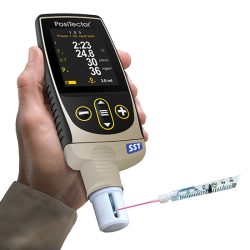
PosiTector SST
For salt readings on blasted or bare steel, our PosiTector SST is a conductivity probe built around the Bresle method rather than a general-purpose lab meter. On-screen prompts take you through reference, sample and record, the gauge times the dwell period for you, and it logs the sample temperature (normalised to 25 °C) with every result. Set the patch volume and it works out surface density in mg/m² or µg/cm² alongside raw conductivity in µS/cm. Its 1 ml test cell suits Bresle sample volumes, and a stored blank carries over when you’re running several tests in a row. It reads 0–1,500 µS/cm (0–6,000 mg/m²), accurate to ±2 µS/cm up to 200 µS/cm, and clips onto the same PosiTector gauge body as our coating thickness, surface profile and dew point probes.
Bresle Patches
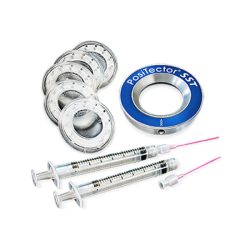
For the extraction itself, we stock two DeFelsko patches, and both work with the PosiTector SST.
The PosiPatch is the reusable option. A magnetic ring holds it against the steel, so there’s no adhesive to peel away or clean up, and a rinse with deionised water gets it ready for the next test. Because the ring is magnetic, it needs ferrous steel to hold on to.
We stock both PosiPatch rings. The Standard ring is for flat steel and for curved surfaces over 1 m in diameter. The Flexible ring bends to seal on pipework and other tight curves, from 10 cm outside diameter or 12 cm inside diameter upward.
The DeFelsko Adhesive Patch is the self-adhesive option: a latex-free polyurethane patch whose low-tack adhesive lifts off cleanly. It works on almost any material or shape, which makes it the one to use on stainless steel, aluminium and other non-magnetic surfaces.
SST Abrasives Test Kit
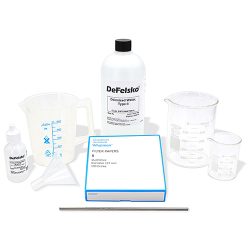
To test the abrasive rather than the steel, the SST Abrasives Test Kit measures soluble salt contamination in abrasive and is designed around ASTM D4940. A sample of abrasive is mixed with deionised water, the liquid is filtered off, and its conductivity is read. It’s a sensible check on recycled media and on new stock from an unfamiliar supplier. The kit supplies the beakers, funnel, filters, mixing rod, deionised water and a certified conductivity standard in a hard-shell case. The conductivity meter is separate, and the PosiTector SST doubles as one.
PosiTest DT
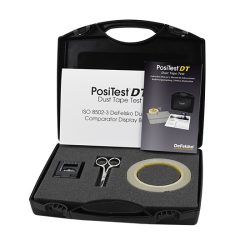
For dust left behind after blasting, the PosiTest DT is a complete ISO 8502-3 dust tape test kit. Press a length of tape onto the prepared surface, lift it, mount it on the transparent display board and grade it against the kit’s pictorial comparator for dust quantity and particle size. An illuminated 10x magnifier helps with the finer particles, and the report forms keep the tape itself as a permanent record, so the test works as a quick pass/fail or as documented evidence for the job file.
We also stock the optional Dust Tape Roller. ISO 8502-3 recommends pressing the tape down with a constant force, and the roller delivers the same pressure on every strip. Thumb pressure varies from person to person, so the roller keeps ratings consistent when several inspectors are testing on one job.
Quick Reference: Which Test For Which Job
- Blasted steel before coating, spec calls for ISO 8502-6/-9 → PosiTector SST with a Bresle patch
- Frequent testing on flat or large-diameter steel, reusable patch → PosiPatch with Standard magnetic ring
- Steel pipe or tight curves, from 10 cm OD / 12 cm ID → PosiPatch with Flexible magnetic ring
- Stainless, aluminium or other non-magnetic surface → DeFelsko Adhesive Patch
- New or recycled blast abrasive, ASTM D4940 → SST Abrasives Test Kit, read with the PosiTector SST
- Loose dust after blasting, spec calls for ISO 8502-3 → PosiTest DT
- Several inspectors grading dust on one job → PosiTest DT with the Dust Tape Roller
- Wash or rinse water conductivity, 0–500 µS/cm → PosiTector SST, test cell dipped in the water
FAQs
Is a salt tester the same as a salt meter, Bresle test kit or chloride test?
Salt tester, salt meter, soluble salt meter and Bresle test kit are all names for the same job: measuring soluble salt contamination on a surface before it’s coated. In coatings work that usually means a conductivity reading taken through the Bresle method, which is what the PosiTector SST does. It’s a quantitative test, meaning it gives you a measured figure rather than just showing whether salt is there. A chloride test is different again. Chloride kits (ISO 8502-5, for example) target one specific ion with test tubes or strips, and their results can’t be compared directly with a conductivity reading. “Salt tester” is also used in other industries, for pools, water treatment and food, to measure salinity in a liquid. The instruments on this page are built for prepared steel and blast media, not for those.
Is the PosiTector SST the same as a Weber Rielly salt test?
No. We’re often asked about the Weber Rielly test (sometimes spelt Weber Reilly), but we don’t supply it. It was developed in South Africa as a quick colour check. A reagent is sprayed over the blasted steel, dries white, and turns pink or red wherever it meets soluble iron salts. Those salts form when chloride or sulphate contamination reacts with rusting steel, so they’re typically found in corrosion pits. The colour is then compared by eye against a chart. That makes it a qualitative test. It’s useful for spotting contaminated pits, but it reacts to iron salts rather than measuring all soluble salt, and it doesn’t give you a figure to record. The SST, by contrast, measures every soluble salt the Bresle sample picks up, so you end up with a number for the job file. The two can work together, with a colour test to find problem areas and an SST reading to confirm the surface is within spec.
Why do salt test results come in different units?
Because they describe different things. µS/cm is the raw conductivity of the water drawn out of the patch. mg/m² and µg/cm² are the same surface density written two ways (10 mg/m² equals 1 µg/cm²), calculated from that conductivity, the patch volume and the area the water covered. Parts per million (ppm) describes a concentration in a liquid, and the Bresle method doesn’t use it. Conversions from ppm to surface density exist, but no test method recognises them. Report in whatever unit your specification uses. The PosiTector SST shows conductivity and surface density together, so there’s no converting by hand.
Do I need a different gauge for concrete or plastic substrates?
Yes. Magnetic and eddy current gauges rely on the substrate being metallic. For concrete, wood, plastic and composite substrates, an ultrasonic gauge is required instead, since it measures using sound rather than magnetism.
What salt level is acceptable before coating?
No one figure applies to every job. The limit comes from the coating specification or the coating manufacturer, and it varies with the coating system and the service conditions. Immersion service, such as tank linings and buried or submerged steel, is usually held to the strictest limits. Always test against the figure in your project specification, in the unit it’s written in.
Does the PosiTector SST tell me which salts are on the surface?
No. It measures the total conductivity of the extracted sample and converts that into a total salt surface density using the ISO 8502-9 calculation, which assumes a seawater-like mix of salts. For blistering, the total is what counts, which is why most specifications set their limit on it. The actual mix on a surface depends on where the salt came from: a site near a chemical plant or power station can carry more sulphates or nitrates, for example, and conductive cleaning residues can push a reading up. Knowing the site’s history helps you read the result. If a specification names a particular ion, such as chloride, it needs an ion-specific test.
What can the PosiTector SST test?
Three things. It tests salt on prepared surfaces using a Bresle patch (ISO 8502-6/-9), salt in blast abrasive together with the SST Abrasives Test Kit (ASTM D4940, ISO 11127-6), and the conductivity of water from 0–500 µS/cm by dipping the test cell straight in, which is handy for checking the water you wash the steel down with.
Do I need a dust test as well as a salt test?
Often, yes, because they catch different things. The salt test finds dissolved contamination you can’t see. The dust tape test (ISO 8502-3) measures loose particles left on the surface, usually broken-down abrasive, which weaken adhesion if they’re painted over. Many specifications ask for both after blasting, alongside a visual cleanliness grade and a surface profile reading. Neither replaces a profile measurement, which is about the texture of the steel rather than its cleanliness.
How often should a salt tester be recalibrated?
A yearly recalibration is the usual starting point, counted from the day the probe goes into use, and it’s what most quality systems ask for. Your project specification or QA procedure may call for a tighter interval, so check it first. Between recalibrations, run the probe against the certified conductivity standard that comes in the box to confirm it’s still reading true.
Can my PosiTector SST be calibrated or repaired in South Africa?
Yes. As well as probe recalibrations, we repair both probes and PosiTector gauge bodies locally. Each SST probe carries its own calibration certificate, so the certificate stays with the probe whichever gauge body you use it on.
Complete you Inspection
Contamination testing is one of several checks a blasted surface goes through before it’s painted. These three are the most closely tied to it.
Measured On The Same Blasted Steel - Surface Profile
Salt and dust tests tell you what’s sitting on the steel. A profile reading tells you how rough the blast left it. Both are usually taken at the same stage, straight after blasting, and a spec will set a separate limit for each. Our surface profile gauges cover the roughness side.
What Turns Salt Into Blisters - Environmental Monitoring
Salt under a coating does its damage by drawing in moisture, so the humidity and dew point on the day you paint go hand in hand with the salt reading. Our environmental monitoring instruments confirm conditions are within spec before and during application.
Where Contamination Can Start Abrasives
Blast media is one of the ways salt reaches the steel in the first place. Our abrasives range covers the media itself, and the SST Abrasives Test Kit above lets you check any batch before it goes into the pot
Not sure which combination your specification calls for? Send it to us and we’ll match the instruments to it.