
A holiday is a break in a protective coating small enough to miss with the naked eye – a pinhole, a thin patch, a void where the film never quite closed over itself. Left undetected, that one gap is where corrosion starts, and it starts underneath a coating that still looks perfect from the outside. On a tank lining, a pipeline, or a structural steel coat, a single missed holiday can undo months of careful surface preparation and coating application before the asset has even entered service.
Storm Machinery represents DeFelsko in South Africa and is an authorised DeFelsko service and calibration centre. Every PosiTest pinhole and holiday detector we supply is genuine DeFelsko stock, backed locally by factory-trained repair, calibration and technical support.
OUR INSPECTION EQUIPMENT
Showing all 2 resultsSorted by popularity

Why It Matters: Voltage Has To Match The Coating
Pinhole and holiday detection isn’t one test – it’s two different methods, and the coating’s own thickness decides which applies. Too little voltage on a thick coating won’t punch through to the substrate, so a real discontinuity slips past as a pass. Too much voltage on a thin coating can arc through sound, defect-free film – the test itself creates the very holiday it was meant to find, and now a good coating needs re-repairing.
That’s why DeFelsko builds a voltage calculator into the PosiTest HHD range rather than leaving the figure to a chart on the wall. Select the standard named on the project spec, key in the coating thickness, and the right test voltage is set before the electrode ever touches the surface. It’s a detail plenty of alternative instruments on the market still skip, and it’s the difference between a test result an inspector can defend on a report and one they can’t.
Built to the Standards Inspectors Specify
DeFelsko’s PosiTest pinhole and holiday detectors conform to the standards most commonly written into coating specifications:
ISO 29601, ISO 14654, ASTM G62, ASTM D5162, ASTM D4787, ASTM D6747, ASTM D7953, NACE SP0188, NACE SP0274, NACE SP0490, BS 7793-2, AS 3894.1, AS 3894.2
Every unit ships standard with a Long Form Certificate of Calibration, and NIST-traceable calibration is available through Storm Machinery locally – no need to ship an instrument out of the country to keep it in spec. Which standard applies on a given job is set by the project specification, not the instrument; the voltage calculator simply makes it fast to test correctly once that’s confirmed.
Buyer's Guide - Choosing the Right Detector
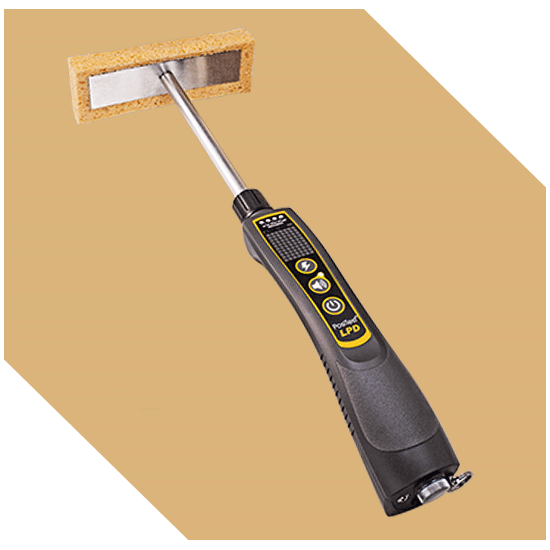
PosiTest LPD Low Voltage Pinhole Detector
For coatings up to roughly 500 microns (20 mils) on metal or concrete, the PosiTest LPD uses the wet sponge method – a low voltage current (9–90 V) that only completes a circuit where the sponge’s moisture can bridge an actual gap in the film. On the finest pinholes, and toward the thicker end of that range, plain water can struggle to reach the substrate through such a small opening; adding a wetting agent (a surfactant) to the sponge solution cuts the water’s surface tension so it penetrates the pinhole instead of beading on top of it. It’s the gentler option for thinner coatings, with GroundSense confirming the unit is properly grounded before the result is trusted, and an IP65-rated, weatherproof housing built for site conditions rather than a lab bench.

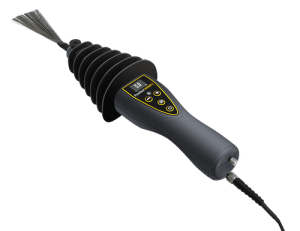
PosiTest HHD High Voltage Holiday Detector
From around 200 microns (8 mils), pulsed DC becomes the more reliable method, and above 500 microns (20 mils) it’s the only one that still works – a wet sponge can no longer force a dependable circuit through a film that thick. Between 200 and 500 microns, both the LPD and HHD are DeFelsko-rated for the job; which one to reach for usually comes down to the standard named on the project spec rather than thickness alone. The PosiTest HHD stick-type configuration pairs a shoulder-worn battery pack with a rolling spring or wire brush electrode, with test voltage set anywhere from 0.5 kV up to 35 kV and a built-in calculator that works out the correct figure against 11 international standards on site. A Long Form Certificate of Calibration and a Pelican Storm case are included as standard.

PosiTest HHD C Compact Wand
Same high voltage detection, single-piece wand – no shoulder bag, no separate battery box – but built around continuous DC rather than the stick-type’s pulsed DC, at a 0.5–30 kV range. That difference decides where each one earns its keep: the PosiTest HHD C suits smaller jobs where the ground clamp can sit directly on the part being tested – a plate, a vessel, a fabricated component. Once the ground point has to sit some distance away – testing an in-situ pipeline earthed to a steel stake driven into the ground nearby, for instance – the stick-type HHD’s pulsed DC is built for that indirect connection instead. At 0.74 kg with an integrated Li-ion battery, the HHD C is still the practical choice for floors, tank interiors, and other confined or hard-to-reach areas, provided the earth point stays close by.
Quick Reference - Which Detector for Which Job
- Coating under ~200 µm (8 mils), metal or concrete → PosiTest LPD only – wet sponge, 9–90 V
- Coating 200–500 µm (8–20 mils) – the overlap zone → either PosiTest LPD or HHD works – check which the project standard specifies
- Coating over ~500 µm (20 mils) → PosiTest HHD (pulsed DC, 0.5–35 kV) or HHD C (continuous DC, 0.5–30 kV)
- Ground point can sit directly on the part (smaller jobs, shop items) → PosiTest HHD C – continuous DC, compact one-piece wand
- Ground point has to sit some distance away (e.g. in-situ pipeline, earthed to a stake) → PosiTest HHD – pulsed DC, built for an indirect ground connection
FAQs
What exactly is a "holiday" in coating inspection?
It’s industry shorthand for a gap in the coating film that shouldn’t be there – the film is too thin, or missing altogether, over one small patch, and bare metal or concrete sits exposed underneath it. Some inspectors call it a pinhole, others a void, a flaw, or a crack, depending on how it formed, but every version boils down to the same thing: a spot that “took a holiday” while the rest of the surface got properly coated. Left in place, it’s exactly where localised corrosion gets its start.
Is a pinhole detector the same thing as a holiday detector?
They test for the same defect using two different methods. “Pinhole detector” usually refers to the low voltage, wet sponge method (like the PosiTest LPD), suited to thinner coatings. “Holiday detector” usually refers to the high voltage, pulsed DC spark method (like the PosiTest HHD), suited to thicker coatings. Both terms turn up in specifications and on site interchangeably, so it’s safer to check the coating thickness than to assume from the name alone.
How do I know which test voltage to use?
Test voltage is set by the coating’s dry film thickness and whichever standard the project specifies – there’s no single universal figure. The PosiTest HHD range includes a built-in voltage calculator that works this out once the thickness is entered and a standard is selected. If a project specification doesn’t name a standard, that’s worth confirming with the specifier before testing rather than guessing.
Can I use a high voltage detector on a thin coating?
Not safely, from a test-accuracy standpoint. Too high a voltage on a thin film can arc straight through sound coating and create a new hole rather than finding an existing one – effectively damaging the coating being inspected. That’s the main reason DeFelsko builds two separate product lines around thickness rather than one detector for everything.
How often does a pinhole or holiday detector need calibration?
Every PosiTest LPD and HHD ships with a Long Form Certificate of Calibration, and annual recalibration is a commonly cited interval in the industry – but the actual requirement can be set by a project specification, client, or the standard being tested to, so it’s worth checking rather than assuming a flat figure applies. Storm Machinery is an authorised DeFelsko calibration and service centre in South Africa if a unit is due.
Can the PosiTest LPD be used on concrete as well as metal?
Yes – the wet sponge method suits coatings on both metal and concrete substrates, which is part of why it’s a standard choice for tank linings and concrete coating systems as well as steel.
Does Storm Machinery repair these instruments locally, or do they need to go back to the manufacturer?
Storm Machinery is an authorised DeFelsko service and repair centre, so servicing, calibration and repairs for the PosiTest LPD and HHD ranges are handled locally in South Africa.
Complete your Quality Control Kit
Pinhole and holiday testing is usually the last check before a coated asset goes into service, not the first – a few other checks in the process pair naturally with it.
Sets The Test Voltage - Coating Thickness Gauges
The PosiTest HHD’s voltage calculator needs a dry film thickness figure before it can set the correct test voltage, so a Coating Thickness Gauges reading is usually the step that comes just before a holiday test, not after it.
Checked Alongside Holiday Testing - Adhesion Testing
A coating can pass a holiday test clean and still fail on site if it was never properly bonded to the substrate. Adhesion Testing is the other major post-application check most specifications call for in the same inspection round.
Where Holidays Start - Environmental Monitoring
Many holidays trace back to conditions during application or cure rather than application technique. Environmental Monitoring equipment catches the humidity and dew point readings that explain why a holiday formed in the first place.
Not sure where a project fits in that sequence? Get in touch and we’ll help point to the right instrument.