
Hardness tells you something a coating thickness reading can’t: whether a material or a cured film will actually hold up to the knocks, scratches, and everyday wear it’s about to face on site. It’s used across metals, plastics, rubbers, and coatings to certify material quality, check repairs, and catch a coating that hasn’t cured properly before it becomes a costly rework. Because the right test method depends entirely on what’s being tested — a soft metal casting behaves nothing like a cured epoxy film — choosing the correct hardness scale is as important as the reading itself.
We carry DeFelsko’s full hardness testing range as the brand’s representative in South Africa and an authorised DeFelsko service centre. Every gauge ships with a Long Form Certificate of Calibration traceable to NIST, and when it’s due for recalibration or a service, our team handles it locally.”
OUR INSPECTION EQUIPMENT
Showing all 2 resultsSorted by popularity
Why Does Hardness Testing Matter?
A hardness reading is often the fastest, cheapest way to catch a problem before it becomes an expensive one. On a coated surface, hardness doesn’t just describe scratch resistance – it’s frequently used as an early indicator of cure state, because a coating that hasn’t fully cured will consistently read softer than the coating manufacturer’s cured specification. Catching that during inspection, rather than after a client complaint, is the difference between a five-minute recheck and a full recoat. The same logic applies to soft metals: a Barcol reading taken on a repaired casting or weld area can flag inconsistent material properties long before a structural issue would otherwise surface.
About DeFelsko's Hardness Testers
DeFelsko’s hardness range covers three internationally recognised test methods, each suited to a different material class:
- Shore hardness (Types A & D): ASTM D2240, ISO 868, ISO 7267, ISO 7619, DIN 53505 – non-metallic materials (rubbers, elastomers, plastics, thick coatings)
- Barcol hardness: ASTM B648, ASTM D2583, DIN EN 59, AS/NZS 3572.22 – soft metals and reinforced plastics
- Pencil hardness (Wolff-Wilborn): ISO 15184, ASTM D3363 – paint and coating films
Every PosiTector hardness gauge ships with a Long Form Certificate of Calibration traceable to NIST – the same certification standard behind Storm’s other DeFelsko instrument ranges – plus a two-year warranty and the accessories needed to start testing on day one.
Caveat: exact acceptance values (e.g. a specified Shore D reading, or a required pencil grade) are set by the coating manufacturer or project specification, not by a universal industry figure – always confirm against the relevant spec sheet or contract document before signing off a result.
Buyer's Guide - Selecting Your Hardness Tester
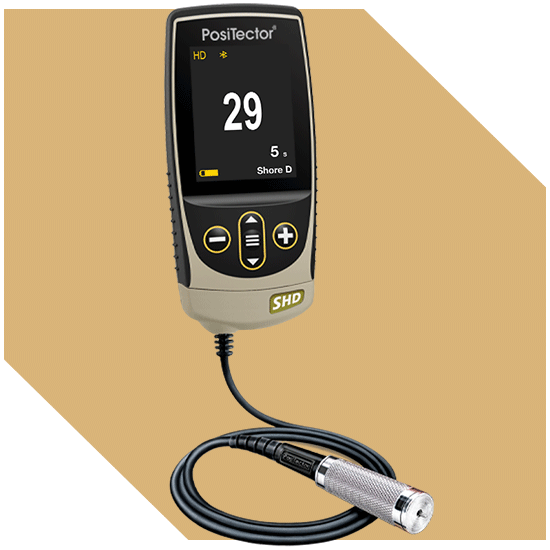
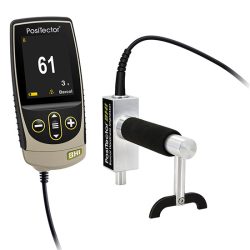
PosiTector SHD - Shore Hardness Durometer
For soft rubbers, elastomers, and plastics, the PosiTector SHD measures indentation hardness on two scales – Shore A for soft rubber, neoprene, and silicone, and Shore D for harder rubbers, epoxies, and rigid plastics like PVC and acrylic. A user-adjustable measurement timer with on-screen countdown keeps every reading consistent with the relevant standard, and results display on a clear digital screen rather than requiring interpretation from an analogue dial.
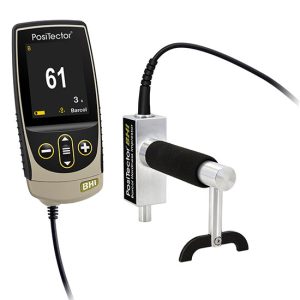
PosiTector BHI - Barcol Hardness Impressor
Where the material is a soft metal rather than a polymer, the PosiTector BHI is the right instrument. It’s built around the Barcol scale, which was originally developed to check soft-metal fittings weren’t secretly substituted with weaker material – the same principle now applies on site when verifying a casting, extrusion, or repaired component is genuinely made from the alloy it’s supposed to be. Reinforced plastics fall under the same scale for the same reason. It’s a soft-metal tester specifically: see the FAQ below on where it doesn’t apply.
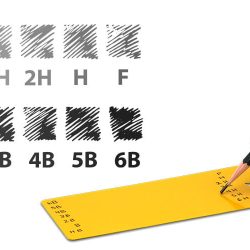
Pencil Hardness Testing (method)
Pencil hardness – also called the Wolff-Wilborn method – tests a coating’s scratch resistance and relative hardness using graduated graphite leads, from 6B (softest) to 6H (hardest), drawn across the surface at a fixed angle. It’s a widely specified method for paint and coating films under ISO 15184 and ASTM D3363.
Quick Reference: Which Hardness Tester for Which Job?
- Soft rubber, silicone, neoprene → PosiTector SHD, Shore A scale
- Hard rubber, epoxy, rigid plastic, PVC, acrylic → PosiTector SHD, Shore D scale
- Aluminium, aluminium alloys, copper, brass (soft metals) → PosiTector BHI, Barcol scale
- Fibre-reinforced plastic, hard composites → PosiTector BHI, Barcol scale
- Paint or coating film scratch resistance / cure check → Pencil hardness method (Wolff-Wilborn)
- Structural or hardened steel (Rockwell/Brinell/Leeb range) → not covered by this range — see FAQ
FAQs
Is Barcol hardness testing the same as metal hardness testing?
Not quite – this is worth being precise about. Barcol hardness testing covers soft metals: aluminium, aluminium alloys, copper, and brass. It doesn’t extend to structural or hardened steel, which is typically tested using Rockwell, Brinell, or Leeb rebound methods on dedicated metal hardness testers – a different instrument category to the PosiTector range. If your application involves hardened or structural steel rather than soft metal components, speak to us before ordering to confirm the right instrument for the job.
What's the difference between Shore A and Shore D hardness?
Both are measured with the same style of instrument but use different indenter geometry and spring force. Shore A is calibrated for soft, flexible materials like silicone and neoprene; Shore D is calibrated for harder materials like rigid plastics and cured epoxies. Using the wrong scale on a given material typically produces a reading that’s difficult to interpret against any published specification.
Can I use a Shore hardness tester on metal?
No – Shore testers are designed for non-metallic materials. For soft metals, use a Barcol tester instead; for harder/structural metals, neither Shore nor Barcol is the correct method (see the metal hardness FAQ above).
How often should a hardness tester be calibrated?
Hardness testers have a built-in daily check that other inspection instruments don’t: every PosiTector SHD and BHI ships with its own reference test block or disc, letting you verify the gauge is reading correctly before each shift without needing to send it anywhere. Full formal calibration – the certificate a specification will ask to see – is a separate, less frequent process; confirm the required interval against your project specification rather than assuming a single figure applies universally. For that formal calibration, Storm Machinery holds its own DeFelsko authorisation for service and calibration, with readings and certificates issued through Storm’s local lab
Does hardness testing tell you if a coating has fully cured
It can be a useful early indicator – a coating that hasn’t reached full cure will generally read softer than the manufacturer’s specified cured hardness. It shouldn’t be treated as a replacement for the coating manufacturer’s official cure-time guidance, but it’s a fast way to flag a potential problem before proceeding to the next coat or handover.
What's pencil hardness testing used for?
It’s a scratch-resistance test for paint and coating films, using graded pencils from 6B to 6H as the indenting tool, in accordance with ISO 15184 and ASTM D3363. It’s most relevant for finished coating films rather than bulk materials.
Do I need different hardness testers for different materials, or is one instrument enough?
Generally more than one, because each method is built around a specific material class. Many inspectors carry both a Shore and a Barcol tester if their work spans coatings, plastics, and soft metal components.
Other Checks in Your Inspection Process
A hardness result rarely stands alone – it’s usually one confirmation among several on the same component or coating system. Storm supplies the instruments for the other checks too:
After Your Hardness Check - Coating Thickness
Once hardness confirms a coating has cured, coating thickness gauges confirm it was applied to spec in the first place.
Behind the Hardness Reading - Surface Profile
For coated steel, the anchor profile underneath is what the hardness and thickness readings are ultimately protecting – see our surface profile gauges for that earlier step.
If a Reading Runs Soft - Environmental Monitoring
If a hardness reading comes back softer than expected, checking whether conditions stayed within the safe cure window is often the next diagnostic step – see our environmental monitoring gauges.