
Our electric airless spray pumps deliver precise pressure control for commercial, residential, and light industrial projects. Powered by standard mains or generators, these self-contained units offer excellent mobility for fast on-site deployment.
With advanced digital motor control, our electric range adjusts instantly to fluid demand. This ensures a consistent spray fan and a flawless finish—perfect for premium architectural paints, decorative coatings, wood finishes, and lacquers.
Browse our range below to find the ideal kilowatt rating and maximum tip size for your contracting crew.

OUR AIRLESS SPRAY EQUIPMENT
Showing all 5 resultsSorted by popularity

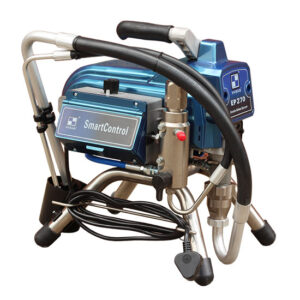
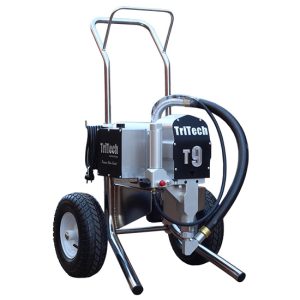


What is an Electric Paint Sprayer?
An electric paint sprayer uses a compact electric motor to generate fluid pressure for spraying, making it the most portable option in the airless range.
- Drive type: Piston-driven (Storm Machinery’s exclusive electric range) or diaphragm-driven.
- Why piston-only: Piston pumps handle a wider range of coating viscosities, hold pressure consistently over long runs, and are easier to service in the field. Storm Machinery moved away from diaphragm pumps after finding them prone to reliability issues under continuous commercial and industrial use.
- Best for: Wall and ceiling spraying, decorative finishes, roof spraying and waterproofing, and light industrial work where portability and precise digital pressure control matter.
- Range: Heavier-duty output (EP450, TriTech T9) through to lighter, portable options (TriTech T4, TriTech T7, EP270). Storm Machinery is an authorized South African distributor of TriTech’s electric spray pump range, alongside our own EP-series pumps.
Common Applications for Electric Spray Pumps
- Roof spraying & waterproofing: Larger electric piston models are a popular choice for rooftop work, where lightweight equipment (roughly the weight of a standard 20-litre paint bucket) lets one operator carry both pump and material up to height. Well suited to elastomeric roof coatings and liquid rubber waterproofing membranes.
- Wall spray & interior/exterior finishes: Compact and easy to maneuver into tight spaces, with precise control for smooth wall, ceiling, and trim finishes.
- Decorative & fine finishes: Digital pressure control supports high-quality aesthetic work on joinery and feature surfaces.
- Medium to large commercial & industrial projects: Larger piston models scale up to handle thicker, high-viscosity protective coatings without sacrificing portability.
How Electric Spray Pumps Work
An electric airless sprayer converts rotating motor motion into the reciprocating (up-and-down) stroke needed to pressurize paint.
- The Motor (Brushless DC vs. PMDC): Modern premium electric sprayers use Brushless DC (BLDC) motors. With no carbon brushes to wear down, they run more efficiently, generate less heat, and deliver high torque at low speeds.
- The Gearbox & Eccentric Drive: A heavy-duty hardened steel reduction gearbox takes the motor’s high-speed rotation and turns it into a straight, vertical stroke via an eccentric crank or wobble drive.
- The Fluid Section: That stroke drives a hardened stainless steel displacement piston in the pump lower. A dual ball-check valve system (foot valve and piston valve) – the same principle used in pneumatic pumps – mechanically pressurizes the paint and forces it out to the gun.
Smart Motor Control : The Dead-Band Secret
Premium electric units use a digital microprocessor paired with a pressure transducer to keep application uniform.
- Instantaneous adjustment: The transducer reads fluid pressure at the manifold thousands of times per second. If pressure drops when the trigger is pulled, the motor instantly spins faster to maintain a flawless fan pattern.
- Tight dead-band control: The “dead-band” is the pressure variance between the pump stopping and restarting. Advanced electric motors keep this dead-band tight, delivering steady, constant fluid velocity – critical for high-end decorative finishes, wood stains, and lacquers where even coating thickness matters.
The Operational Golden Rule For Electric Pumps
Rule: Never undersize an electric motor for high-viscosity coatings.
- What happens if you do: The motor can technically increase torque to push thicker paints (like heavy elastomeric waterproofing membranes), but doing so consistently forces it to draw maximum current.
- Why it matters: This causes thermal buildup, shortening the lifespan of the electronic control boards and accelerating packing wear.
- How to apply it: Always match the motor’s maximum fluid output to the maximum tip size required by your coating’s technical data sheet.
Typical coatings for electric spray systems
- Architectural & Decorative Finishes: Optimized for high-production spraying of premium interior and exterior PVAs, acrylics, and enamels from Dulux (Trade range), Plascon (Micatex / Cashmere), and Prominent Paints.
- Waterproofing & Liquid Rubber: Easily atomizes elastomeric roof barriers and liquid rubber waterproofing membranes like Cemcrete, Sika, or Darachem.
FAQs
Do electric spray pumps need a compressor?
No. An electric motor generates fluid pressure directly, with no external compressor or air supply required. This is what makes electric pumps the most portable option in the airless range.
Are electric spray pumps suitable for roof spraying and waterproofing?
Yes. Larger electric piston models are a popular choice for rooftop work and waterproofing projects, including elastomeric roof coatings and liquid rubber membranes. Their light weight (similar to a standard 20-litre paint bucket) lets one operator carry both the pump and material up to height
Can electric spray pumps handle wall spraying and decorative finishes?
Yes. Compact electric models are ideal for wall, ceiling, and trim spraying, offering precise digital pressure control for smooth, high-quality decorative finishes.
What's the difference between electric and pneumatic airless spray pumps?
Electric pumps use a motor-driven piston and need no compressor, making them lighter and easier to move between sites. Pneumatic pumps use compressed air for higher sustained output on large industrial jobs, but require a compressor on site.
Do you supply diaphragm-driven electric sprayers?
No. Storm Machinery supplies piston-driven electric pumps exclusively, having moved away from diaphragm pumps after finding them prone to reliability issues under continuous commercial and industrial use.
How do I choose the right electric spray pump?
Match the pump’s maximum fluid output to the tip size and viscosity specified on your coating’s technical data sheet. As a rough guide: lighter models suit wall spraying and decorative finishes, while heavier-duty models suit roof spraying, waterproofing, and industrial coatings.
Looking for the Complete Setup?
Finish your setup with our spray guns, tips, and hoses. And if an electric pump isn’t quite what you’re looking for, explore our full range of airless paint sprayers – including pneumatic and hydraulic systems.
Disclaimer: Always refer to your paint data sheet for equipment recommedations or consult our sales team. Reference to these commercial coatings is for informational and machine-compatibility purposes only and does not imply official endorsement, sponsorship, or affiliation between Storm Machinery and the respective paint manufacturer.