
Our hydraulic airless spray pumps are engineered for massive volume and continuous, large-scale commercial applications. Powered by heavy-duty petrol or diesel engines or high-output electric motors, these rugged machines deliver unyielding torque to shift high-viscosity coatings over massive areas.
With a slow-stroking hydraulic piston design, our range minimizes mechanical wear while maximizing fluid delivery. This makes them the ultimate high-production solution for heavy roof membranes, block fillers, high-build architectural coatings, and protective liners.
Our hydraulic range – the SM-9800P petrol, SM-9600D diesel, and SM-9800E electric – is Storm Machinery’s own SM line, sold and supported directly by our team in Johannesburg, Durban, and Cape Town. With no distributor in between, your spares, servicing, and technical advice all come from the people who supplied your pump. Browse our range below to find the ideal flow rate and maximum tip size capacity for your high-volume projects.

OUR INSPECTION EQUIPMENT
Showing all 3 resultsSorted by popularity


A Brief Guide on Hydraulic Spray Pumps
Hydraulic airless spray units are the definitive choice for high-volume contractors executing large-scale commercial, infrastructure, and protective roofing projects. Engineered for continuous duty cycles, these high-production machines excel at moving high-viscosity materials that would stall standard mechanical drivetrains.
How a Hydraulic Airless Pump Works
A hydraulic airless pump puts a sealed oil circuit between the power source and the paint. That extra stage is what gives it such a smooth, slow stroke:
- Power source: A petrol engine, diesel engine, or 220V electric motor drives a hydraulic pump, which pressurises oil drawn from the unit’s reservoir.
- Hydraulic motor: That pressurised oil is routed to a hydraulic motor, where a changeover valve reverses the flow at the end of every stroke – driving the piston up, then down.
- Fluid section: The hydraulic piston is coupled to the paint pump’s displacement rod, which draws coating in through the intake and pushes it out to the hose and gun at spraying pressure.
- Return: The oil cycles back to the reservoir, carrying heat away from the drive as it goes.
What Distinguishes Hydraulic Units from Electric & Pneumatic?
- Smooth, Linear Power Delivery: Unlike mechanical gearboxes that experience high wear under extreme loads, hydraulic systems use pressurized hydraulic oil to stroke the displacement piston. This creates an incredibly smooth, slow stroke that reduces friction and extends packing life.
- Large-Tip, High-Build Capability: Because the hydraulic motor delivers massive, unyielding torque, these units can easily handle large-bore spray tips – up to 0.051″ on our petrol and diesel models – to apply ultra-thick, high-build materials over massive square meterages.
- Effective Heat Management: Hydraulic oil doubles as a cooling medium, carrying heat away from the drive and back to a 13-litre reservoir on every SM unit – fan-cooled on the SM-9800P petrol model. That’s what helps these machines hold their output through long shifts in hot South African conditions.
The Operational Golden Rule for Hydraulic Pumps
Because the fluid section utilizes a longer stroke and a slower cycle rate compared to smaller electric units, it moves a much higher volume of paint per cycle. This slow-stroking action significantly reduces abrasive wear on the piston and packings, making hydraulic units the most cost-effective long-term choice for high-volume architectural contracting and roof-barrier applications
Pressure or Volume? Knowing Where Hydraulic Fits
It’s worth being clear about what a hydraulic pump’s extra muscle actually buys you. Our SM units top out between 220 and 230 bar – the same pressure band as an electric airless pump. Where they pull ahead is volume: up to 12 litres a minute through tips as large as 0.051″, hour after hour, which is what keeps large surfaces moving.
If your coating’s Product Data Sheet calls for more atomising pressure than that, a pneumatic pump is the better match. Our guide to Selecting the Correct Airless Spray Pump explains how pressure, viscosity, and hose length work together.
Working Safely With a Hydraulic Rig
Every airless pump can cause a high-pressure injection injury, and hydraulic units are no exception – read the safety guidance on our Airless Spray Equipment hub for how to recognise one and why it’s always a medical emergency. A hydraulic rig adds a few points of its own:
- Two pressure systems, not one. Relieve paint pressure as your manual describes before clearing a tip, changing a tip, or disconnecting a hose – and never loosen a hydraulic line or fitting while the unit is running.
- Engine exhaust. Petrol and diesel engines produce carbon monoxide. Run them outdoors or in well-ventilated areas only – never inside a tank, basement, or other enclosed space.
- Fuel and hot surfaces. Shut the engine down and let it cool before refuelling, and keep fuel, solvents, and coatings well clear of the engine and exhaust.
- Earthing. Earth the pump, hose, and gun as the operating manual specifies – around flammable coatings or solvents, correct earthing is what manages static discharge
Common Applications for Hydraulic Spray Pumps
- Large roofing & waterproofing projects (roof decks, podiums, and below-grade structures): Liquid-applied membranes and waterproofing systems go on thick and cover big areas – exactly the combination a slow-stroking pump handles best. With up to 12 L/min of delivery and tips up to 0.051″, a hydraulic unit keeps a heavy membrane flowing across a large roof without stopping to catch up.
- Masonry, block work & civil structures (new-build walls, foundations, and retaining walls): Block fillers and bituminous foundation coatings go on thick and need a generous tip and steady volume to fill the surface properly. Hydraulic rigs can run those large orifices for long stretches, and the long, slow stroke keeps packing wear down while they do.
- Off-grid & self-powered work (new builds, infrastructure, and rural projects): The petrol SM-9800P and diesel SM-9600D carry their own power, so there’s no compressor to hire and no generator to run. If your site does have a reliable 220V supply and you’d rather avoid engine exhaust, the SM-9800E gives you the same hydraulic drive from a plug.
- Protective & corrosion-control work (tank exteriors, pipework, and plant upkeep): Our SM units can spray certain protective and corrosion-control coatings, which is useful when a maintenance crew has a lot of steel to cover and no compressor on site. Pressure decides which coatings qualify: check the spraying pressure on the Product Data Sheet against our 220–230 bar range, and if it asks for more, a pneumatic pump is the right tool.
- Petrochemical & fuel-handling sites (refineries, depots, and plant maintenance): Diesel is the engine type these sites most often permit where petrol engines and standard electric motors aren’t allowed, which is why the SM-9600D is the unit we recommend for them. The site’s own permit and hazardous-area rules still have the final say – confirm with the site safety officer, and earth the pump as its manual specifies.
- High-volume commercial & architectural repaints (warehouses, shopping centres, and large residential complexes): When a job is measured in thousands of square metres rather than hundreds, flow rate becomes the deciding factor. A hydraulic pump keeps a high-output tip fed through a full shift – which is where the slow stroke pays off in fewer packing changes and less downtime.
Typical Coatings for Hydraulic Spray Systems
The categories below are where our hydraulic range does its best work. Every product behaves differently, so your coating’s Product Data Sheet always has the final say on pressure and tip size – if in doubt, send it through and we’ll check it against the right pump.
- Heavy Roofing & Performance Coatings: Hydraulic spray pumps are engineered for continuous, large-scale application of thick, high-build roof membranes, liquid-applied membrane systems, heavy acrylic waterproofing, and thick bituminous coatings.
- Masonry Fillers & Sealers: Block fillers and primer-sealers that level out new blockwork before the topcoat. They go on thick, so a large tip and steady delivery make the difference between an even film and a patchy one.
- High-Build Architectural Coatings: Thick textured and elastomeric wall coatings for large commercial and residential exteriors, where film build and coverage rate both matter.
- Selected Protective Coatings: Anti-corrosion primers and protective topcoats whose recommended spraying pressure sits within our 220–230 bar range. The data sheet tells you which ones qualify; anything that needs more pressure belongs on a pneumatic pump.
Disclaimer: Always refer to your paint data sheet for equipment recommendations or consult our sales team.
Buyer's Guide - Choosing Your Hydraulic Pump
Power source is the real dividing line in our hydraulic range. All three SM units share the same slow-stroking drive and 13-litre oil reservoir, so start with what’s available on your site, then check the pump’s pressure and maximum tip size against your coating’s Product Data Sheet. Every unit can also run two guns, so two operators can work off one pump. Each gun then takes a smaller tip, because the pump’s output is shared between them.
SM-9800P Petrol
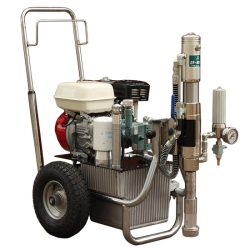
For contractors moving between sites with no power on hand, the SM-9800P Petrol is the lightest unit in the range at 88 kg. A 4.1 kW Honda GX petrol engine drives it through a direct shaft, delivering up to 12 L/min at a maximum of 228 bar, with tips up to 0.051″. Built-in fans cool the oil reservoir, helping it hold its output on long, hot days.
SM-9600D Diesel
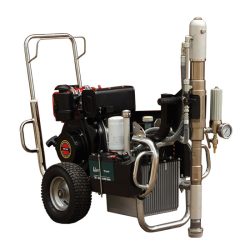
For petrochemical work and industrial sites where petrol engines aren’t permitted, the SM-9600D Diesel runs on a 4 kW belt-driven diesel engine with electric start. It matches the petrol unit’s 12 L/min delivery and 0.051″ maximum tip, with the range’s highest pressure at 230 bar. At 124 kg it’s the heaviest of the three, but it’s still a rugged stand-alone unit that’s easy to manoeuvre on site.
SM-9800E Electric
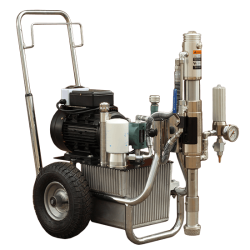
For sites with a reliable 220V supply, or work areas where engine exhaust isn’t acceptable, the SM-9800E Electric gives you hydraulic drive straight from a plug. Its 3.75 kW motor delivers up to 9 L/min at 220 bar with tips up to 0.047″, and with no fuel to manage and no compressor to hire, setup is as simple as finding a socket.
Quick Reference: Which Hydraulic Pump for Which Site
- Off-grid sites with nothing to plug into → SM-9800P Petrol (lightest, 88 kg) or SM-9600D Diesel
- Petrochemical or fuel-handling sites → SM-9600D Diesel, subject to the site’s own hazardous-area rules
- Mains power available, no engine exhaust wanted → SM-9800E Electric
- Two operators on one pump → any SM unit (two guns, with smaller tips on each)
- Largest tips and highest flow → SM-9800P or SM-9600D (0.051″ tips, 12 L/min)
- Coating needs more than 230 bar → a pneumatic pump is the better match
- Always confirm against your coating’s Product Data Sheet before settling on a model.
FAQs
Why are hydraulic airless pumps called "slow-stroking"?
The name describes how the fluid section moves: a long piston stroke at a low cycle rate, rather than the short, quick strokes of a smaller electric unit. That steady motion is behind the range’s long packing life and high output per cycle. See “Why the Slow Stroke Pays Off” above for what it means on a job.
Is the SM-9800E a hydraulic pump or an electric pump?
Both, in a sense – it’s a hydraulic pump powered by an electric motor. Its 220V motor drives the hydraulic system, which then strokes the paint piston, so you get hydraulic’s long, slow stroke without a fuel engine. That’s different from the pumps in our Electric Pumps range, which drive the piston mechanically and are designed to be lighter and easier to carry.
Do hydraulic spray pumps need a compressor?
No. Every unit in our hydraulic range carries its own drive – the SM-9800P and SM-9600D run on petrol and diesel, and the SM-9800E only needs a 220V supply. If you already have compressed air on site and want to use it, that’s what our pneumatic pumps are designed for.
Can I use a hydraulic pump on a petrochemical site?
Often, yes. The diesel SM-9600D is the unit we recommend for these sites, since diesel is the engine type they most commonly allow where petrol engines and standard electric motors aren’t permitted. The final say always sits with the site’s own permit and hazardous-area requirements, so confirm with the site safety officer before you mobilise, and earth the pump as its manual specifies.
Can a hydraulic pump spray protective or corrosion coatings?
Yes, certain ones. Our SM units handle a range of protective and corrosion-control coatings, but pressure is the figure to check. They top out at 220–230 bar, so look at your coating’s Product Data Sheet for its recommended spraying pressure. If it calls for more than that, a pneumatic pump is the better match. Not sure? Send us the data sheet and we’ll confirm.
Can one hydraulic pump run more than one gun?
Yes. Every unit in our SM range can run two guns, which lets two operators cover a large area from a single pump. The pump’s output is shared between the guns, so each one runs a smaller tip than a single gun could. Your Product Data Sheet and our team can help you size the tips for a two-gun setup.
What's the largest spray tip a hydraulic pump can run?
In our range, up to 0.051″ on the SM-9800P petrol and SM-9600D diesel, and up to 0.047″ on the SM-9800E electric. Your coating’s Product Data Sheet will recommend a tip size – our guide on How to Choose the Right Airless Spray Tip Size explains how hose length and temperature can shift it.
How do I look after a hydraulic airless pump?
Follow the service schedule in your pump’s manual. Day to day, three things matter most: flush the fluid section thoroughly after every job, check the hydraulic oil level and condition as the manual describes, and keep the petrol or diesel engine serviced to its own schedule. When your pump needs attention, you can bring it to any of our three branches – see Equipment Repairs & Servicing for how it works.
Complete Your Rig
Getting the most from a hydraulic rig depends on what’s connected to it. The gun, the tip, and the gear your operator wears all decide how well that steady volume turns into a finished surface – and how safely. Here’s what to pair with your SM pump.
Spray Guns - Built for Heavy Material
At up to 12 litres a minute, the gun has to keep pace with the pump. For thick roof membranes, fillers, and bituminous coatings, a filterless front-entry design lets thick material through without clogging mid-shift. Browse our Spray Guns range to match one to your coating.
Spray Tips - Sizing for High Volume
Heavy coatings often call for a large orifice, so check your pump’s maximum tip rating before you size up – a tip bigger than the pump can feed will cost you pressure at the gun. Our Spray Tips range covers the sizes these coatings typically need.
Spray Painting PPE - Operator Protection
Spraying heavy coatings at volume puts more material in the air around your operator. Our Spray Painting PPE range covers the respiratory and protective gear your team needs – matched to what your coating’s Safety Data Sheet calls for.
Still deciding between pump types? Our Airless Spray Equipment hub explains where hydraulic, electric, and pneumatic each earn their place – worth a look before you settle on your kit.