
Conventional spray equipment – also called air spray – atomizes paint by mixing it with compressed air at the gun’s air cap, rather than forcing it through a tip under high pressure. That mechanism is what gives conventional guns their reputation for fine control and a smooth finish, and it’s why they’re commonly used across industrial and commercial applications, not just decorative work – matched to your coating, per the paint’s technical data sheet, not the size or setting of the job.
Every gun, pump and accessory in Storm’s conventional air spray range – pressure pots, diaphragm pumps, spray guns and accessories – is stocked and supported by our own in-house team, with parts, repair kits and technical advice coming straight from the people who know the equipment inside out. From precise decorative work through to full industrial coating runs, including coatings like inorganic zinc primers, our selection includes reliable guns and pumps that deliver control, durability and consistent results.
BROWSE OUR CONVENTIONAL SPRAY CATEGORIES
OUR CONVENTIONAL EQUIPMENT


How Does Conventional Air Spray Work?
A conventional (air spray) gun mixes paint with compressed air right at the gun’s air cap, breaking it into a fine, even mist as it leaves the nozzle – that’s atomization in practice, and it’s the mechanism behind the fine control and smooth finish conventional guns are known for. Pull the trigger, and the needle draws back from the fluid tip to release paint while compressed air flowing through the air cap shapes and atomizes it into the spray pattern.
How paint actually reaches the gun depends on the feed type: pressure-fed guns draw paint from a separate pressurised pump or pot through a hose, suited to continuous, higher-volume spraying; gravity-fed guns have an on-gun cup that feeds paint by gravity, better suited to precise, detail-oriented work; and hopper-fed guns are built for a different job entirely – plaster and texture spraying rather than paint finishing. Our Buyer’s Guide below covers which one fits your job.
Most conventional guns run in the 29-58 psi (roughly 2-4 bar) range at the gun – check your specific gun’s spec sheet when sizing your compressor. HVLP (High Volume Low Pressure) and LVLP (Low Volume Low Pressure) are lower-pressure variants of the same air-atomization mechanism, built for higher transfer efficiency and less overspray than a standard conventional gun. Storm’s own conventional range includes HVLP-rated guns for that finer control — see the Buyer’s Guide below for which model fits your job.
Why Choose Conventional Air Spray?
- Fewer wearing parts, lower running cost – when it’s properly maintained. Conventional spray equipment doesn’t rely on a high-pressure piston pump or the seals that go with one. Fewer moving parts under load generally means simpler troubleshooting and a lower total cost of ownership over the life of the equipment – one of the clearest, most defensible reasons to choose conventional over a high-pressure system when raw output speed isn’t the deciding factor. That advantage holds only with regular cleaning and maintenance, though: skip it, and the same parts that would otherwise last will wear out early, pushing you toward replacement equipment sooner and eroding the cost saving this is built on.
- Control that shows up in the finish. Atomizing paint with compressed air, rather than forcing it through a tip at hydraulic pressure, gives the operator finer control over spray pattern and material flow. That control is exactly why conventional guns are a strong choice for detail and decorative work – appliance and metal-fabrication finishing, general woodworking, panel beating, and touch-up jobs – where control over the spray pattern matters as much as how fast it goes on. Select guns in our range are HVLP-rated, built for the finer atomization and lower overspray that panel beating and other detail-critical work demand – see our Buyer’s Guide below for which model fits. Conventional equipment does still handle a genuine range of industrial coatings, inorganic zinc primers among them – matched correctly to your paint’s data sheet, not limited by job type or scale.
- The trade-off: transfer efficiency. Standard conventional guns typically transfer somewhere around 40% of sprayed paint onto the surface, with the rest lost to overspray – well below airless, which can reach up to around 70%. That’s a genuine cost, in material and in cleanup time, and it’s worth planning for rather than discovering on the job.
- A different, and generally less severe, risk profile than airless. Airless equipment’s most serious hazard is high-pressure fluid injection injury, caused by forcing liquid through a pinhole tip at hydraulic pressure far beyond what compressed-air atomization reaches. Conventional guns don’t operate at those pressures, so that specific hazard doesn’t apply in the same way. That doesn’t make conventional risk-free: compressed air itself still carries real risks, including air injection injury from compressed air held against the skin, plus standard eye and hand hazards that apply to any spray equipment. Proper PPE and safe handling practice still matter.
Storm's Conventional Air Spray Range - Stocked and Backed In-House
Storm Machinery stocks and supports its conventional spray equipment through our own technical team here in South Africa, backed by local parts and service. That means:
- Genuine spare parts and repair kits held in local stock, not ordered in from overseas on a job-critical timeline.
- Technical support and troubleshooting advice from our own technical team, not a call centre reading from a manual.
- A track record with South African workshops and industrial users who run this equipment daily, in local conditions.
Buyer's Guide: Which Conventional Air Spray Category Do You Need?
Matching equipment to your job comes down to your paint’s technical data sheet – viscosity, volume solids and coating type all affect what a gun or pump can handle. Volume solids affects how much pressure it takes to push coating through the delivery hose, but there’s no fixed percentage that decides conventional versus airless on its own – some coatings spray well through conventional equipment even at very high volume solids, so check your data sheet against the pump or gun’s actual pressure rating rather than estimating from volume solids alone. Inorganic zinc coatings are one we know conventional equipment sprays well; always check your data sheet against the equipment’s spec before you buy, whether you’re choosing conventional or airless.
Air Spray Guns
Whatever the job – from decorative work to full industrial coating – the right conventional spray gun comes down to your paint’s data sheet as much as the finish you’re after. Storm’s range spans three feed types:
- Pressure-fed – the 905 Conventional Gun (1.5mm/1.8mm/2.5mm nozzles, robust and durable, HVLP-rated, built for industrial applications and panelbeating work) and the AM6008 Conventional Spray Gun (1.4mm/1.8mm nozzles, lightweight, HVLP-rated, suited to industrial and commercial work) – draw paint from a separate pressurised pump or pot rather than an on-gun cup, making them the choice for continuous, higher-volume spraying.
- Gravity-fed – the AM5008 Conventional Spray Gun (1.2mm/1.4mm nozzles, fitted with a 600ml cup, HVLP-rated) – is built for commercial and decorative work, where precise control matters more than continuous volume.
- Hopper-fed – the Hopper Spray Gun (4mm/6mm/8mm nozzles) – is a different application entirely: plaster and texture spraying rather than paint finishing.

Paint Pressure Pots
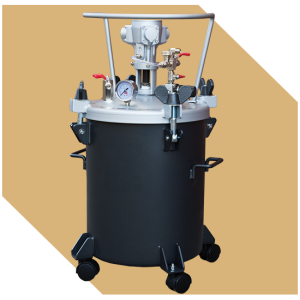
For finer control over the volume of coating reaching the gun, we recommend a paint pressure pot: a pressurised tank that forces coating through the paint hose using compressed air, instead of relying on a gravity-fed cup that needs constant refilling. The Agitated 10L and Agitated 20L Paint Pressure Pot are easier to clean than a diaphragm pump for this reason. Max working pressure on the 20L unit is 4 bar; both come with stainless steel inner liners and an air-agitator, and are rated for inorganic zinc coatings.

Diaphragm Pumps
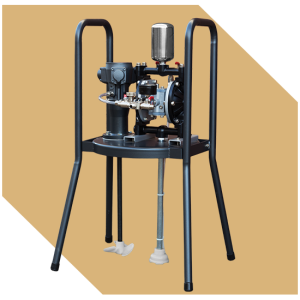
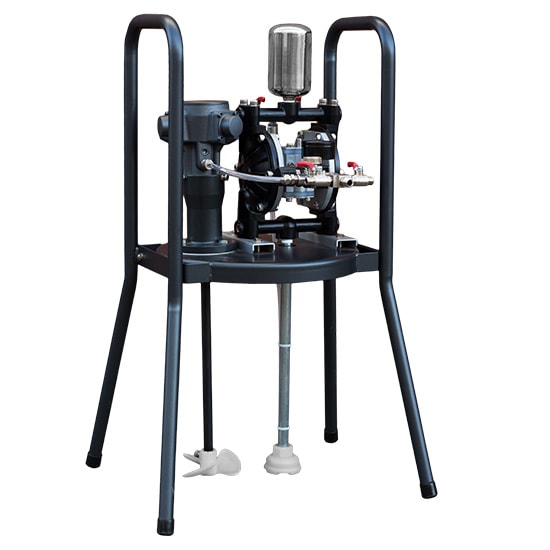
For production environments spraying continuously through the day, we recommend a diaphragm pump: it transfers paint directly and non-pressurised from a 20L/25L bucket, and can run two spray guns simultaneously for higher throughput. The Standard Diaphragm Pump DP3 and Agitated Diaphragm Pump DP5 deliver up to 28 LPM at up to 7 bar (1:1 ratio); the DP5 adds a variable-speed agitator (useful for coatings that settle, like zinc-rich primers), while the DP3 is the same pump without it. Both are rated for inorganic zinc coatings and oxides.
Air Spray Accessories
Our air spray accessories cover the hose, repair kits, filters and smaller parts that keep a conventional setup running – and that wear out first.

Quick Reference
This is a starting point, not a one-size-fits-all – always check your paint’s data sheet before deciding, whichever spray method you’re weighing up.
- Need a gun for general or industrial work? Our conventional spray guns span pressure-fed, gravity-fed and hopper-fed options – see the Buyer’s Guide above for which feed type fits your job.
- Spraying continuously through the day in a production environment? A diaphragm pump is built for that.
- Want finer control over how much coating reaches the gun? A pressure pot gives you that.
- Keeping your setup running? Our air spray accessories cover the hose, filters and the smaller parts that wear out first.
- Need to cover a large area fast, or spray a thick, high-build coating without thinning? See our range of airless paint sprayers instead.
FAQs
Is conventional spray equipment low-maintenance?
Yes and no – worth separating two different things. Conventional guns have fewer high-wear parts than a high-pressure pump system, which generally means lower long-term maintenance and repair costs (if cleaned properly – neglect it and those same parts wear out early). But per-job cleaning time is a separate, real cost: conventional guns need thorough cleaning between colours or coating types, which adds labour time to every job. Budget for both
Why does my finish look rough or dry after spraying?
This is usually “dry spray” – paint that partially dries in the air before it reaches the surface, leaving a rough, poorly adhered finish. It’s most often caused by holding the gun too far from the surface, spraying at too high a pressure, or working in hot or windy conditions that make the material flash off too quickly. Adjusting gun distance and pressure, and controlling thinner flash-off, usually resolves it.
Does conventional spray equipment need special compressed air?
Yes – the air feeding a conventional gun needs to be clean, moisture-free and oil-free. Any contamination in the air supply shows up directly in the finish, so an inline air filter or dryer is worth budgeting for alongside the gun itself.
Do I need to thin my paint for conventional spraying?
Often, yes. Conventional guns are generally suited to lower-viscosity material, so many coatings need thinning to spray correctly – always check your paint’s technical data sheet for the manufacturer’s recommended thinning ratio rather than guessing. If you’re working with thicker, high-build coatings you’d rather not thin, our airless range is built to handle that without thinning.
What's the difference between conventional and airless spray equipment?
The short answer: airless uses hydraulic pressure alone to force paint through the tip, built for speed and heavy coverage; conventional uses compressed air to atomize the paint, built for control and finish quality. Read the full comparison in our article What is Airless Spray?.
Is conventional spray equipment cheaper to run than airless?
Generally yes, on two fronts: the equipment itself tends to cost less upfront, and with fewer high-wear parts, day-to-day running costs are typically lower too. The trade-off is transfer efficiency – standard conventional guns lose more material to overspray (commonly cited around 40%, compared with up to around 70% for airless) – so material cost per job can offset some of that saving depending on what you’re spraying.
What's the difference between a paint pressure pot and a diaphragm pump?
A pressure pot is a pressurised tank – compressed air forces coating through the hose to the gun. It’s easier to clean and gives finer control over coating volume. A diaphragm pump transfers paint directly and non-pressurised from a bucket, and can run two spray guns at once for higher throughput. Which one you need depends on your production setup and coating type.
What's the difference between a pressure-fed and gravity-fed spray gun?
A pressure-fed gun (like the 905 or AM6008) draws paint from a separate pressurised pump or pot through a hose, suited to continuous, higher-volume spraying. A gravity-fed gun (like the AM5008) has an on-gun cup that feeds paint by gravity, suited to precise, detail-oriented work. Both are conventional (compressed-air) systems – the difference is how paint reaches the gun, not how it’s atomized.
Is conventional spray the same as air spray?
Yes – they’re two names for the same equipment. Conventional spray atomizes paint by mixing it with compressed air at the gun’s air cap; “air spray” is the newer term for the same mechanism, increasingly used across the industry. Storm Machinery leads with “conventional” throughout this site – including the page title – since it’s the more commonly searched term, and uses “air spray” alongside it as a familiar, supporting name. Either way, it’s a different mechanism from airless (which uses hydraulic pressure alone, with no air) and from HVLP/LVLP (which are conventional/air spray sub-types built for higher transfer efficiency).
How do I know if I need airless instead of conventional?
It comes down to your paint’s technical data sheet, not a fixed volume-solids percentage – some coatings spray well through conventional equipment even at very high volume solids. What actually decides it is pressure: if your data sheet calls for more pressure to move the coating than a conventional pressure pot or diaphragm pump is rated for, that’s the point to look at our Airless range instead, which runs at far higher pressure (up to around 570 bar) specifically for thicker, higher-build coatings. Check your data sheet against the equipment’s spec rather than estimating from volume solids alone.
Does my paint hose need a specific pressure rating?
Yes – a hose’s pressure rating should always match or exceed the working pressure of the pump or pot it’s connected to, since that pressure is what’s actually forcing paint through it. The higher the pump’s working pressure, the higher the hose’s safety rating needs to be – check the rating before pairing a hose with a higher-pressure pump.
Complete Your Setup
A great finish doesn’t start and end with the gun. Getting there – and confirming it’s holding – means preparing the surface properly beforehand and checking the result against spec once the job’s done. Storm supplies what you need for the full job, not just the spray equipment itself.
Need Higher Output? - Airless Spray Equipment
For large jobs or thick coatings where speed and coverage matter more than fine control, our airless spray equipment range is built for exactly that.
Surface Preparation - Blast Pots
Before the first coat goes on, the surface needs the right profile – free of rust, scale and contaminants the coating won’t properly bond to. For industrial projects, our blast pots range gets the surface ready before you spray.
Quality Control - Inspection Equipment
Once the job’s done, confirming it actually meets spec is what protects the finish. Our inspection equipment range helps you check coverage, thickness and profile against what your paint’s data sheet calls for.