
Dustless blasting isn’t a new process – it’s been around for some time. But demand for it has grown as environmental and health and safety constraints have tightened, making airborne dust a harder problem for sites to ignore. Some sites simply can’t tolerate that dust at all, and that’s exactly where a dustless setup earns its place. By introducing water into the blast stream alongside the abrasive, a dustless blast pot can suppress up to 95% of airborne dust when paired with the right abrasive, trading some blasting speed for the ability to work where a dry pot would be a health, safety, or site-access problem. On site, you’ll hear the same process called wet sandblasting, dustless sandblasting, hydro sandblasting, or slurry blasting depending on who you’re talking to – different names, same application.
OUR BLAST POTS
Showing all 3 resultsSorted by popularity
The Trade-Off Nobody Mentions: Flash Rust & Spent Abrasive
Putting water into a blast stream solves the dust problem, but it introduces a different challenge: freshly blasted steel is bare, reactive, and now wet, which is exactly the condition flash rust needs to take hold – sometimes within hours. Left unmanaged, that surface can start rusting again before a coating ever goes on, undoing the surface preparation you just paid for. The fix is a rust inhibitor additive mixed into the blast water itself, which raises the water’s pH to offset acidic abrasives and holds rust at bay for a defined window – long enough to get the surface coated.
Getting this right follows a specific order, though – the inhibitor isn’t a shortcut around cleaning. If there’s already grease on the surface, degrease and clean it before blasting; then use the inhibitor in the blast water itself while you work – it lifts oil, grease, and residual salts (nitrates, sulphates, chlorides, phosphates) both out of the water and off the surface, on top of holding off flash rust. What it doesn’t remove is the spent abrasive itself: the surface still needs a rinse-down after blasting to clear that away – more on why below. Skipping any part of that sequence is easy, and expensive to regret – it’s the detail that separates a dustless setup that’s genuinely production-ready from one that just looks the part on paper.
Tested, Documented, and Backed by Storm
- Compliance here is the same as everywhere else in our blast pot range: pressure tested in accordance with SANS 347 – the South African National Standard covering how pressure equipment is grouped and safety-checked, not a certification in itself – under the Pressure Equipment Regulations, with a conformity assessment report confirming compliance. See our main Blast Pots page for the full standards breakdown.
- Every standalone pot is supplied with its own pressure vessel data pack. The default pressure test interval is every three years, under the Pressure Equipment Regulations. If the pot is used on a mine site, the Mining Act of South Africa requires testing every year instead – confirm which applies to your job rather than assuming the general rule.
- Conversion devices – the Vapour Injection Kit and water injection nozzle – attach to an existing pressure vessel rather than being one themselves, so the pressure test obligation follows the pot they’re fitted to, not the conversion device itself.
- Storm Machinery offers OEM training on all equipment purchased through us, dustless setups included – water injection changes how a pot is operated, not just what it sprays.
Buyer's Guide
Only one of the products below is a standalone dustless pot on its own – the other two are conversion devices that adapt an existing dry pot to dustless operation. Worth knowing before you buy, since it changes what you’re actually ordering.
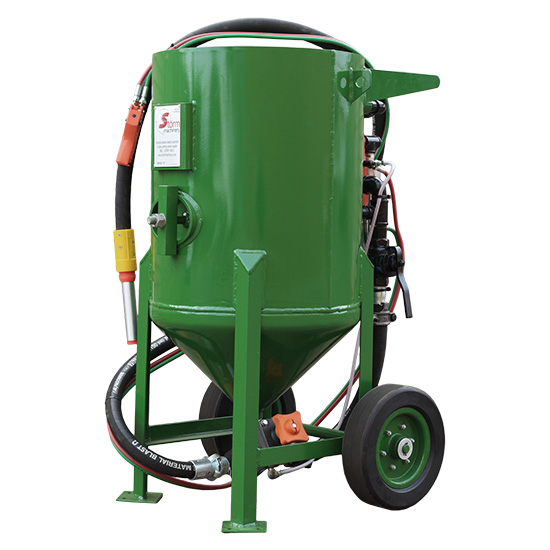
Slurry Blast Pot
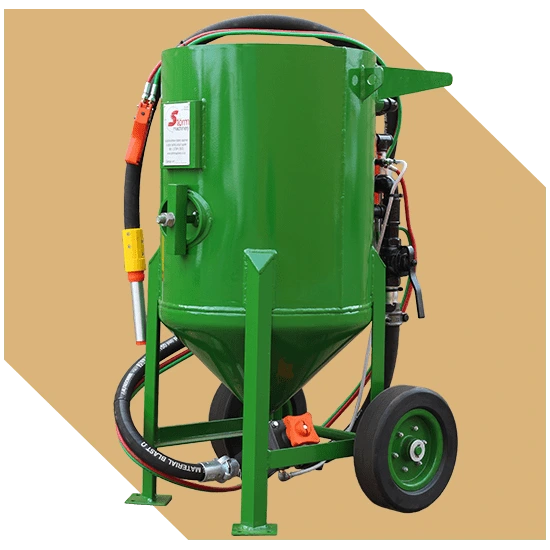
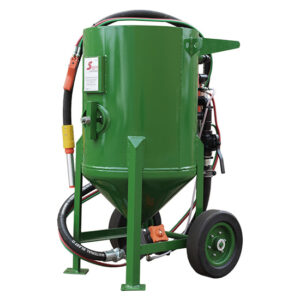
The only true standalone option here – a purpose-built dustless Slurry Blast Pot, designed from the outset to blast with water already in the mix, rather than an existing dry pot converted afterwards. The right choice if you’re buying new and know dust control is a fixed requirement, not an occasional one. Sometimes called hydro sandblasting on site – a term that’s easy to mix up with a different piece of equipment entirely, so see the FAQ below for the distinction. Water goes in by hand here, poured directly into the pot rather than fed from a running supply. You’ll still need a water source to fill from – it’s just not a continuous connection. That means the job stops to refill whenever either the water or the abrasive runs out, so plan ahead if frequent stops don’t suit the job. Unlike the Vapour Injection Kit, there’s no way to fine-tune the water once you’re blasting – the ratio is fixed by how it’s filled and set up. It also only runs with abrasive sized between 0.5mm and 0.8mm, a narrower range than dry blasting allows, so check your media against that before ordering. Operation itself is otherwise identical to a dry pot, which makes this a straightforward switch for operators already trained on dry blasting.
Vapour Injection Kit
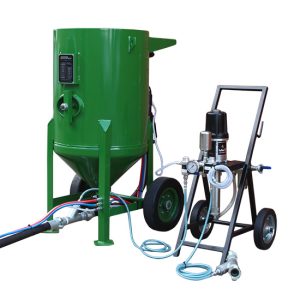
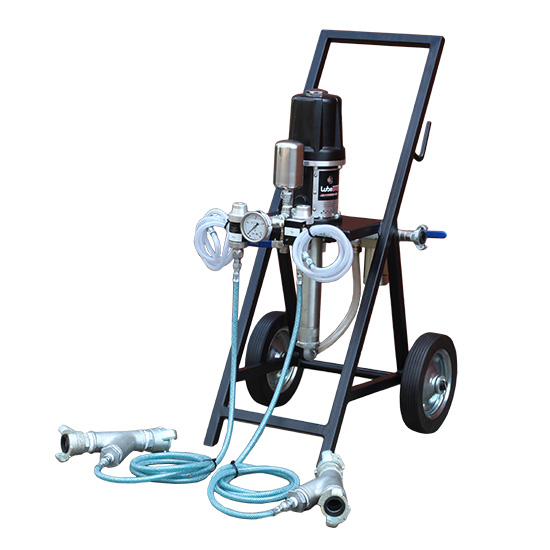
If you already own a dry blast pot and want to add dust control without replacing it, the Vapour Injection Kit introduces a controlled fine mist into the blast stream at the bottom of the pot, on your existing setup. It converts an existing pot rather than being one in its own right, and it isn’t a pressure vessel itself – factor that into what you’re actually comparing on price. It’s built for fine-tuning, too – an adjustable pressure regulator and gauge let you dial the water flow anywhere from a light mist up to a higher rate, so you can match dust suppression to the job rather than running one fixed setting. It also connects directly to a tap or running water outlet, so there’s no need to stop and top up a reservoir by hand mid-job. Because the supply is continuous, the job only ever stops for an abrasive refill – never for water. It can just as easily draw from a water tank instead – handy if you want to pre-mix a rust inhibitor into the water supply. One kit can also supply two blast pots at once, useful for larger crews without needing to double up on equipment.
Low Pressure Water Injection Nozzle
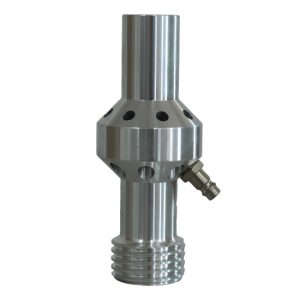
A simpler, nozzle-level way to add water injection to an existing dry pot, for sites where a full Vapour Injection Kit is more than the job calls for. Like the kit above, the Low Pressure Water Injection Nozzle is a conversion device, not a standalone pot – and not a pressure vessel in its own right either. It runs at a fixed water rate – set by whatever your municipal water supply (or similar fixed-pressure source) delivers, rather than the Kit’s adjustable regulator. That simplicity is part of what keeps it the lower-cost option.

Quick Reference Block - Which Dustless Setup for Which Job
- Buying new, dust control is a fixed requirement → Standalone Slurry Blast Pot
- Already own a dry pot, want dust control added → Vapour Injection Kit conversion
- Already own a dry pot, want a simpler, lower-cost option → Low Pressure Water Injection Nozzle conversion
- Dust levels vary between jobs or areas on the same site → The Vapour Injection Kit’s adjustable pressure regulator dials water flow from a light mist up to a higher rate as conditions change
- Dust levels are consistent, no need to fine-tune → Slurry Blast Pot and Low Pressure Water Injection Nozzle both run a fixed water rate, set once rather than adjusted on the fly
- Need to confirm your abrasive is compatible → Slurry Blast Pot only runs abrasive sized 0.5mm-0.8mm (check before ordering)
- Operators are already trained on dry blasting → Slurry Blast Pot operates the same way – no new technique to learn
- Site has a tap or running water connection to work from → Vapour Injection Kit feeds directly off it, no manual refilling
- Running more than one blast pot on the crew → One Vapour Injection Kit can supply two blast pots at once
- Want to pre-mix a rust inhibitor into your water supply → Vapour Injection Kit can draw from a water tank instead of a tap
- Don’t have a plumbed water connection on site → Slurry Blast Pot is filled by hand from any water source – no continuous connection needed
- Want to minimise refill stops during the job → Vapour Injection Kit only needs an abrasive refill – the water supply is continuous
- Fine with periodic stops for both abrasive and water → Slurry Blast Pot needs refilling for either one
- Want the flexibility to switch back to dry blasting from the same pot → The Slurry Blast Pot can convert to a conventional, single-chamber dry setup with the right components
- Freshly blasted steel needs to stay clean before coating → Add a rust inhibitor to the blast water – extends the coating window by up to 72 hours
- Want the full rust-inhibitor process right → Degrease first if the surface is already greasy, add inhibitor during blasting, rinse off spent abrasive after – all steps matter
FAQs
What is a dustless blast pot?
A dustless blast pot introduces water into the compressed-air abrasive stream, suppressing the dust that a conventional dry pot would otherwise throw into the air. It’s the same core blasting process as a dry pot, with water added at the point the abrasive is released.
Is dustless blasting the same as wet sandblasting, dustless sandblasting, hydro sandblasting, or slurry blasting?
Yes – “wet sandblasting,” “dustless sandblasting,” “hydro sandblasting,” and “slurry blasting” all describe the same water-in-the-blast-stream process, just different names used across the industry. They’re not different equipment or methods, just different terminology for the same setup.
Hydro Sandblasting vs High Pressure Blasting - is there a difference?
Yes, and it’s worth knowing before you go looking for either one. “Hydro sandblasting” (and Storm’s own Slurry Blast Pot) combines water with abrasive in the same blast stream, for the same surface preparation purpose as any dustless setup – stripping and profiling a surface before coating. “High pressure blasting” – also called hydro water blasting, or UHP (ultra-high-pressure) blasting – refers to pure high-pressure water jetting with no abrasive at all, used for tank, pipe, and industrial cleaning rather than surface preparation. That’s a different category of equipment entirely, and not part of Storm’s blast pot range. If a supplier says “high pressure blasting,” it’s worth confirming which one they actually mean.
Do I need a completely new pot to go dustless, or can I convert what I already have?
Either works. A standalone Slurry Blast Pot is dustless by design, while a Vapour Injection Kit or water injection nozzle converts an existing dry pot to add water injection without replacing it. Which makes sense depends on whether you’re buying new or already own a dry pot in good condition.
Does water injection cause the steel to rust before it's painted?
It can, if left unmanaged – bare, freshly blasted steel is reactive, and introducing water raises the risk of flash rust setting in before coating. This is managed with a rust inhibitor mixed into the blast water, which extends the usable coating window by up to 72 hours. The right inhibitor also works oil, grease, and residual salts off both the water and the surface itself while you’re blasting – but if the surface is already greasy, that’s not a substitute for degreasing it before you start, and you’ll still need to rinse off the spent abrasive afterward. It’s a step worth budgeting for, not an optional extra.
How much slower is dustless blasting than dry blasting?
Dustless blasting is commonly cited as roughly 20–30% slower than dry blasting. Water causes adhesion – it pulls the blast pattern in tighter than the wider pattern a dry pot produces, so the same amount of blasting covers less ground. To blast economically with a dustless setup, aim for at least 7 bar of pressure at the nozzle, and we recommend our XP Venturi Nozzle, built specifically to compensate for this drop in performance. The exact gap can still vary by abrasive, nozzle setup, and site conditions, so treat the percentage as a general guide rather than a fixed figure for your job.
Do I still need a water trap and aftercooler with a dustless setup?
No – a dustless setup that runs on water injection removes the moisture-in-the-airline problem a water trap and aftercooler are there to solve for a dry pot, since water is already part of the process by design.
How often does a dustless blast pot need to be pressure tested?
Only the pot itself needs pressure testing – the Vapour Injection Kit and water injection nozzle aren’t pressure vessels, so they don’t carry a separate testing requirement of their own. For the pot, the default interval is every three years, under the Pressure Equipment Regulations – the same interval that applies across our dry range. If you’re working on a mine, though, the Mining Act of South Africa requires testing every year instead. This is checked against SANS 347, the national standard covering how pressure equipment is grouped and safety-checked. Confirm which interval applies to your site rather than assuming the general figure.
Does a dustless setup need a different grit valve?
Only if you’re converting a dry pot into a full slurry setup, where water and abrasive mix together in the pot itself – that needs a Macro Metering Valve instead of a standard grit valve, since it’s rated for metering abrasive alongside water. Using the Vapour Injection Kit or the water injection nozzle instead doesn’t change this: water is introduced downstream of the pot, so the dry pot’s plumbing – including its standard grit valve – stays exactly as it is.
Beyond the Blast Pot
Dust control is one part of a bigger blasting job – the abrasive you blast with, what you do with freshly stripped steel, and what comes next in the coating process all connect to the setup here:
The Right Media
Every dustless pot still needs the right media running through it. Browse our range of silica-free abrasives.
Check the Result
Once blasted and coated, verify the job with surface profile gauges, environmental monitoring instruments, and coating thickness gauges.
Get It Coated
Move straight from a clean, profiled surface into airless spray painting equipment for large-scale work, or conventional spray equipment for smaller jobs – ideally within the coating window your rust inhibitor buys you.
Still not sure whether you need a dustless setup in the first place? Dustless vs Dry Sandblasting breaks down the full comparison – cost, speed, and when each one makes sense. Our Blast Pots main page touches on the decision too, but that article is where the detail actually lives. Everything above assumes you’ve already landed on dustless and just need to work out which of our products fits your setup.