
Engineered for extreme industrial corrosion protection, our pneumatic airless spray pumps deliver the raw power needed to spray today’s heaviest high-solids coatings. Powered entirely by compressed air, these heavy-duty rigs multiply fluid pressure effortlessly, ensuring a smooth, continuous flow even through exceptionally long hose runs.
Our pneumatic range – the 30:1 President, SX Series, and Storm King – is exclusive to Storm Machinery, backed directly by our own team for service, support, and spares, with no third-party distributor in between. That direct relationship is what makes this range the choice for rugged environments like shipyards, structural steel fabricators, and heavy-duty spray booths across South Africa.

OUR AIRLESS SPRAY EQUIPMENT
Showing all 3 resultsSorted by popularity


Technical Guide for Pneumatic Spray Pumps
Pneumatic airless spray pumps are the undisputed industry standard for high-output, industrial-grade coating applications. Unlike electric units that rely on mechanical drivetrains, pneumatic systems utilize compressed air to drive a reciprocating fluid piston, offering unparalleled power density for demanding industrial environments.
Understanding the mechanics, pressure ratios, and displacement volumes of these pumps is critical to matching the correct unit to your coating’s viscosity and your job site’s production demands.
How Pneumatic Airless Pumps Work
At the core of a pneumatic airless pump is a simple, highly efficient thermodynamic and mechanical process: Force Multiplication.
- The Air Motor: High-pressure compressed air enters the air motor through a directional spool valve. This valve rapidly cycles, directing air alternately above and below a large-diameter air piston, forcing it to move vertically up and down.
- The Connecting Rod: The air piston is directly coupled via a connecting rod to a smaller-diameter fluid displacement piston located in the lower fluid section.
- Fluid Displacement (The Lower Section): As the fluid piston moves up (the intake stroke), it creates a vacuum that draws coating material past a lower check-valve (foot valve ball). On the downstroke, the lower check-valve closes, and the upper check-valve opens, forcing the trapped fluid out of the pump section at extreme pressure into the fluid hose.
Atomization: Because no air is mixed with the paint (hence “airless”), atomization occurs purely through mechanical shear force when the high-pressure fluid is forced through the minute orifice of the spray tip.
Safety First: High-Pressure Injection Injury
Airless spray guns don’t atomise paint with compressed air – they force it through a tiny orifice at extreme pressure, and pneumatic pumps sit at the top of that pressure range, reaching up to 500 bar (over 7,000 psi) depending on the model. At that pressure, a spray gun can inject fluid through skin in a fraction of a second – even through a glove, and even with the trigger only briefly engaged.
The wound this leaves can look like nothing more than a small puncture or a graze – the real danger is beneath that skin, where the injected material spreads through tissue and can cause serious harm, including risk to fingers or limbs if it isn’t treated immediately. Workplace safety authorities are consistent on this point – any high-pressure injection injury is a medical emergency, not a minor wound, and needs treatment straight away. The treating doctor will also need to know exactly what was in the gun, from the coating’s Safety Data Sheet, to treat it correctly.
The standard precautions are straightforward: never point the gun at yourself or anyone else, engage the trigger lock whenever you’re not actively spraying, and always release pressure – by triggering the gun into a waste container – before clearing a blocked tip, changing a tip, or disconnecting a hose. These take seconds, and they’re the difference between a routine day on site and a medical emergency.
This isn’t a substitute for your own site’s safety procedures or your pump’s operating manual – always follow your employer’s safety protocol and the manufacturer’s instructions for your specific equipment.
Understanding Pump Ratios
When evaluating industrial pneumatic pumps, you will always see them designated by a ratio, such as 47:1, 63:1, 75:1, or 95:1 (found in our SX Series). This ratio is the fundamental mechanical advantage profile of the pump.
In practical terms, it tells you how many bar of fluid pressure the pump produces for every bar of air pressure you feed it.
Across our range, that translates to an output of 180–500 bar depending on the model and ratio you choose – comfortably above the 210–230 bar an electric or hydraulic unit typically supplies, which is why pneumatic is the pump type to reach for once a coating gets too thick or heavy-bodied for an electric or hydraulic pump to atomise properly. For the full pressure-ratio formula and more on matching pump type to your coating, see our guide on Selecting the Correct Airless Spray Pump.
Common Applications for Pneumatic Spray Pumps
- Heavy industrial & infrastructure projects (shipyards, bridge work, and structural steel fabrication): Pneumatic pumps are built for the scale of shipyards, bridge work, and structural steel fabrication, with the high fluid output and long hose-run capability to keep pace with the volumes these projects demand. Every pump in the range includes an earthing point – properly earthed before use, this is what makes it safe to operate around flammable coatings and atmospheres, not the fact that it happens to run on air rather than an electric motor.
- Protective & corrosion-control coatings (rust prevention on steel and marine substrates): High-build epoxies and polyurethanes only protect properly once they’re built up to the coating manufacturer’s specified Dry Film Thickness (DFT) – and since DFT can’t be measured while the paint’s still wet, checking Wet Film Thickness (WFT) as you spray is the standard way to confirm you’re tracking to target before the coating cures. Hitting that thickness means enough atomising pressure to lay the material on in fewer, heavier passes – exactly what a 47:1 to 95:1 pneumatic ratio is built to deliver.
- Thick, heavy-bodied coatings (viscous paints and industrial sealants): Thick, heavy-bodied coatings need more atomising pressure to break up properly than a 210–230 bar electric or hydraulic pump can comfortably supply – pneumatic’s 180-500 bar range is what keeps them spraying smoothly instead of stalling the pump. Always check the coating’s own Product Data Sheet for its exact pressure requirement rather than relying on a general rule of thumb.
Typical Coatings for Pneumatic Spray Systems
We describe our pump range by what a coating needs – chemistry, volume solids, and required pressure — rather than by naming specific paint ranges, since that’s what actually determines the right equipment. Match your coating’s own Product Data Sheet against the categories below, or send it to our technical team for a straight answer.
- High-Solids Epoxies & Linings: Built for high-build, high-solids epoxy and polyurethane linings – the two-component protective systems used for heavy-duty corrosion control, where every pass needs to lay down enough wet film to hit the specified dry film thickness without sagging or pinholing.
- Fire-Protective Coatings: Sustains the pressure needed to build thick intumescent fireproofing coatings up to their specified thickness in fewer passes, rather than repeated light coats.
- Hull & Ballast Tank Coatings: Handles the heavier, high-solids anti-fouling systems used on hulls and ballast tanks in the same shipyard environments these pumps are built for.
Buyer's Guide: Choosing Your Pneumatic Pump
All three ranges below run on the same force-multiplication principle explained above – the difference is how much volume and pressure each is built to deliver. Always check your coating’s own Product Data Sheet (PDS) for its recommended pressure and volume-solids range before choosing a model: matching the pump to the coating, not just to the job, is what keeps a spray pattern consistent from the first coat to the last.
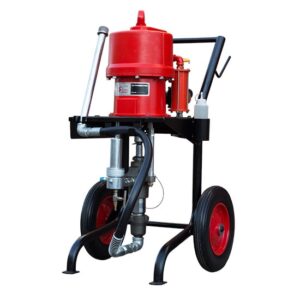
30:1 President
For lower-volume, finer-finish work – wood coatings, touch-up-grade protective work, and lighter commercial jobs – the 30:1 President is Storm’s most compact pneumatic option. Its 30:1 ratio delivers up to 180 bar at 3.8 LPM on as little as 6 bar of shop air, and at 28 kg with an easy strip-down lower section, it’s built to move around a site rather than sit fixed in one bay.
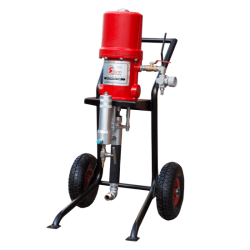
Storm King
For high-output work on bridges, tanks, and large structural steel jobs, the Storm King is built for volume as well as pressure – up to 15.8 LPM on the 45:1 K290, or up to 441 bar on the 63:1 K220, depending on which side of that trade-off your job needs. Double-gun operation lets two operators spray from one unit to keep large jobs moving, and a large 3/4″ heavy-duty air regulator gives fine control over atomising pressure across a wide range of coating viscosities.
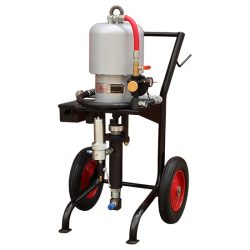
SX Series
For Storm’s most demanding industrial jobs, the SX Series is built to spray up to 100% volume solids without stalling – our largest and strongest pneumatic range. It’s stocked across four ratios, from SX290 at 47:1 up to SX145 at 95:1, so you can choose a lower ratio for higher volume output or a higher ratio for coatings that need more atomising pressure per pass. An anti-freezing ventilation system and manual restart button keep it running through the cold-paint stalling that affects lighter pumps, and its open, quick-strip design keeps servicing fast when it does need attention.
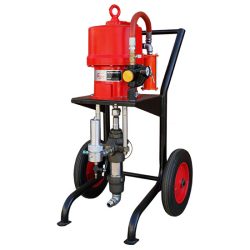
Quick Reference: Which Pneumatic Pump for Which Job
- Lower-volume, fine-finish work (wood coatings, touch-up-grade protective work, lighter commercial jobs) → 30:1 President
- Heaviest industrial jobs, up to 100% volume solids (choose your ratio from 47:1 to 95:1) → SX Series
- High-volume output plus double-gun operation (bridges, tanks, large structural steel) → Storm King
- Choosing between pneumatic, electric, or hydraulic? Pneumatic is the pump type built for coatings that outrun a 210-230 bar electric or hydraulic pump – compare all three on our Airless Spray Equipment hub, or check your coating’s Product Data Sheet for the pressure it actually needs.
- Always confirm against your coating’s own Product Data Sheet (PDS) before settling on a specific model.
Disclaimer
Disclaimer: Always verify the required tip size and minimum fluid pressure against your coating manufacturer’s Product Data Sheet (PDS). If you’re unsure on your pump ratio, chat with our technical team for a precise breakdown.
FAQs
What does a pump ratio like 63:1 actually mean?
It’s the mechanical advantage between the air side and the fluid side of the pump – a 63:1 pump multiplies every bar of compressed air you feed it into roughly 63 bar of fluid pressure at the spray tip. See “Understanding Pump Ratios” further up this page for a worked example, or our full guide on Selecting the Correct Airless Spray Pump for the underlying formula.
Do I need a compressor to run a pneumatic pump?
Yes – pneumatic pumps run entirely on compressed air rather than an internal motor, so you’ll need a compressor sized to your specific pump’s air consumption. Check your model’s Product Data Sheet, or chat with our technical team, to size a compressor correctly before you buy.
When should I choose pneumatic over an electric or hydraulic airless pump?
Once a coating is too thick or heavy-bodied for a 210–230 bar electric or hydraulic unit to atomise properly, pneumatic is the pump type built for it. Your coating’s Product Data Sheet is the definitive guide here – always check its recommended pressure and volume before choosing. For a full side-by-side comparison of all three pump types, see our Airless Spray Equipment hub or our guide on Selecting the Correct Airless Spray Pump.
Is Storm's "Storm" pneumatic range a separate brand?
No – “Storm” is simply the name of our own pneumatic pump range, including the SX Series and Storm King. It’s sourced and supported directly by Storm Machinery, not a third-party brand.
Are pneumatic pumps safe to use in confined or hazardous spaces, like tank linings or shipyards?
They can be, provided they’re properly earthed. Every pump in our pneumatic range includes an earthing point, and connecting it correctly before use is what manages static-discharge risk in these environments – running on compressed air rather than an electric motor doesn’t make a pump spark-free on its own. Always confirm the specific safety requirements of your site, including its earthing procedure, against the relevant standards for that environment.
What coatings can a pneumatic pump spray?
High-solids epoxies and polyurethanes, intumescent fireproofing, and marine-grade anti-foulings are typical – anything where volume solids and required film thickness call for more atomising pressure than an electric or hydraulic pump provides. See “Typical Coatings” above for the categories we regularly support.
My coating isn't named here - how do I know if it needs a pneumatic pump?
Check your coating’s Product Data Sheet for its recommended pressure and volume – once it calls for more pressure than a 210–230 bar electric or hydraulic pump supplies, pneumatic is the right category. Still not sure? Send us the PDS and we’ll confirm the right pump for your specific coating.
How often does a pneumatic pump need servicing?
Service intervals vary by model and how hard the pump works, so always follow the schedule in your specific pump’s manual. Three habits prevent most of the call-outs we see across the range: flush the fluid section after every use, check air-line filters regularly, and don’t leave the pump pressurised or full of coating between jobs. For your model’s full maintenance schedule, refer to the manual it shipped with, or contact our technical team. When it’s time for a service or a repair, we handle it directly for every pneumatic pump we sell – see our Repairs & Servicing page for details.
Complete Your Spray Application
A pneumatic pump on its own is only half the setup. The gun and tip you run it with shape your finish just as much as the pump does, and once the coating’s down, confirming it was applied correctly is what protects the investment you’ve just made. At Storm Machinery, we supply everything you need to complete your pneumatic setup, from first spray to final inspection
Spray Guns - Application Control
Your spray gun is the pump’s trigger – it decides exactly when and where all that built-up pressure gets released, and on a high-pressure pneumatic setup that control matters more than on any other pump type in the range. Pick between TriTech’s premium imports and our own house-brand option, matched to whatever coating you’re spraying through this pump, in our full range of Airless Spray Guns to find the right match.
Spray Tips - Finish & Pattern Control
Tip size and fan pattern decide your finish – and your running cost – just as much as the pump itself. Our Airless Spray Tips range runs on one industry-standard sizing system across both RAC5, our in-house tip, and TriTech’s imported premium line – so switching between them is a matter of picking the size and pattern your job calls for, not hunting for a compatible fit.
Coating Thickness Gauges - DFT & WFT Verification
Hitting the Dry Film Thickness your coating specifies is only half the job – confirming you actually got there is what protects the investment. Our precision Coating Thickness Gauges let you check Wet Film Thickness as you spray and Dry Film Thickness once it’s cured, so any shortfall gets caught before the coating’s fully committed.
Still weighing pneumatic up against an electric or hydraulic pump? Compare all three on our Airless Spray Equipment hub before you finish kitting out your setup.