
Our airless spray guns give you total start/stop control over your paint flow. Built to safely handle extreme pressures, these rugged hand-held units act as the master valve—holding back the paint until you pull the trigger and send it through to the spray tip for final atomization.
Whether you need a filterless front-entry gun for thick industrial fireproofing or a rear-entry gun with a built-in filter for smooth commercial finishes, our range is built to reduce hand fatigue and keep your team spraying efficiently.
Browse our selection below to find the right pressure rating, trigger style, and fluid setup for your next project.

OUR AIRLESS SPRAY EQUIPMENT
Showing all 6 resultsSorted by popularity

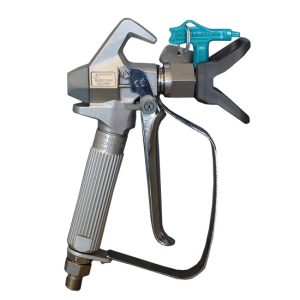
A Brief Technical Guide on airless spray guns
The airless spray gun is the vital mechanical gatekeeper of any high-pressure coating system. While the pump generates the raw fluid pressure, the gun acts as the critical start/stop control valve, managing the fluid path safely before it reaches the spray tip for final atomization.
Selecting the correct gun and tip combination is essential for maximizing transfer efficiency, managing operator fatigue during long shifts, and ensuring a safe, controlled release of high-pressure material.
How an Airless Spray Gun Works: The Core Mechanics
Unlike air-assisted or HVLP systems, an airless system relies purely on fluid pressure to move paint, meaning the gun handle and internal needle must withstand extreme mechanical stress.
- The Fluid Needle & Seat: At rest, a heavy-duty, spring-loaded needle is forced tightly against a diffuser seat inside the gun head, completely blocking the fluid path.
- The Start/Stop Action: When the operator pulls the trigger, the needle retracts instantly. This allows the pressurized coating to flow unimpeded past the seat and travel forward to the gun head.
- The Path to the Endpoint: Once the gate is opened, the fluid passes through the safety guard and enters the spray tip – the true endpoint of the system where the material undergoes sudden depressurization, shearing into a precise fan pattern.
Key Technical Decisions to consider with your airless gun
When choosing an airless spray gun, industrial buyers look at three primary specifications to match their pump setup:
- Pressure Rating (bar) (psi): Standard commercial architectural guns are usually rated around 250 (bar) / 3600 (psi). For heavy industrial applications – like those running high-ratio pneumatic pumps – guns must be rated for 500 (bar) / 7250 (psi) or higher to safely handle extreme pressures without mechanical failure.
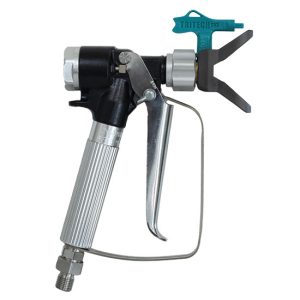
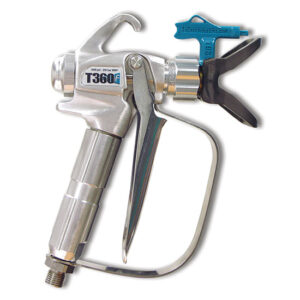
- 2-Finger vs. 4-Finger Triggers: This comes down to operator leverage. A 4-finger trigger offers significantly more mechanical leverage, making it easier to hold open during massive, continuous square-meterage projects like roof barriers or structural steel. A 2-finger trigger provides tighter, more responsive control for precise architectural cutting-in and fine-finish work.
Front Entry vs. Rear Entry Airless Spray Guns
Selecting the correct gun configuration is essential for optimal performance, efficiency, and finish quality. The choice between Front Entry and Rear Entry designs depends directly on your coating viscosity and filtration requirements.
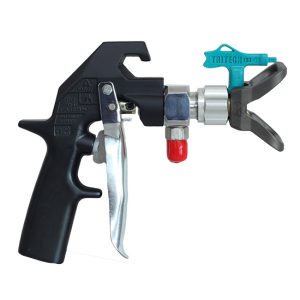
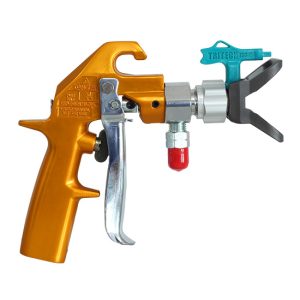
Front entry airless gun
Front Entry guns are engineered for high-viscosity, high-volume coatings typically found in the corrosion protection and fireproofing industries.
- Large Fluid Entry Ports: Designed with oversized internal passages to significantly improve the flow of thick materials.
- Filterless Design: These guns feature no internal gun filter, allowing heavy, aggregate-filled coatings to pass through freely without clogging.
- Dampened Pressure Fluctuations: The direct fluid path reduces pressure drops during pump changeover cycles, which is especially critical when running heavy pneumatic airless pumps.
- Industrial Maneuverability: Because these setups handle stiff, heavy-duty hoses, Front Entry guns are best paired with a gun swivel or a flexible airless whip hose to improve operator comfort in tight or confined spaces.
rear entry air gun
Rear Entry guns are the standard across residential and commercial painting applications due to their exceptional versatility and finish control.
- Integrated Filtration: These guns incorporate a built-in, replaceable handle filter to catch contaminants before they reach the spray tip.
- Variable Mesh Options: Operators can swap between fine and coarse filter meshes to perfectly match the specific architectural coating being applied.
Reduced Downtime: By trapping debris early, this design minimizes tip blockages, prevents spitting, and ensures a highly consistent surface finish
Important Filtration Rule: Always consult the coating manufacturer’s Technical Data Sheet (TDS) before using an internal gun filter. Certain heavy or structured coatings contain components that will be stripped out or restricted by fine filtration, directly impacting the product’s performance.
Looking for the Complete Setup?
A premium spray gun is only half the equation. To achieve maximum production rates, flawless pressure delivery, and industrial-grade reliability, pair your gun with our world-class line of electric, pneumatic, and hydraulic airless paint sprayers.