
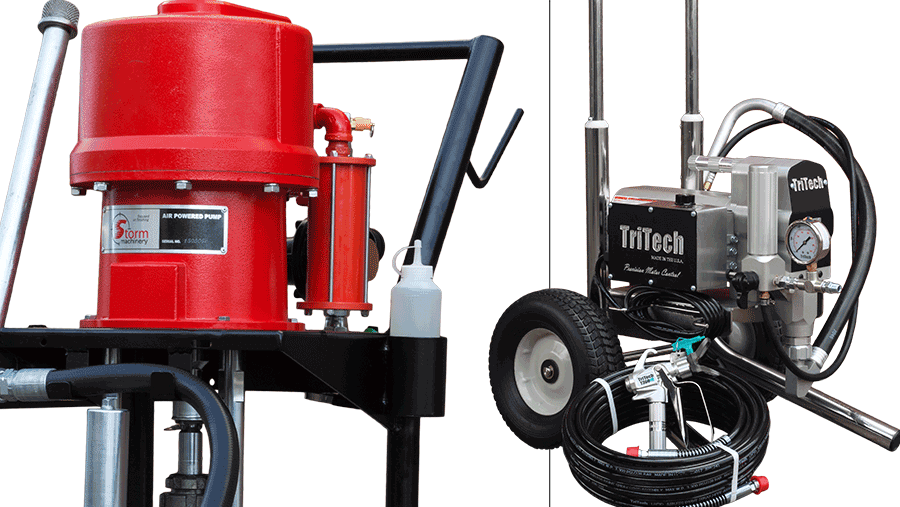
Selecting the Correct Airless Spray Pump
Choosing the right airless spray pump comes down to one thing above all else: knowing your paint. Get that right,
Home / What Is Airless Spray? How Airless Paint Spraying Works
Airless spray is one of the most widely used ways to apply paint and protective coatings – yet it’s still often confused with conventional spray painting. If you’re new to it, or weighing it up against other methods, this guide covers what airless spray is, how it works, how it compares to conventional and HVLP spraying, and where it does (and doesn’t) make sense.
Airless spray is a way of applying paint by pressurising the paint itself, so it atomises without any help from compressed air. A pump pushes paint through a high-pressure hose to the spray gun, where it’s forced through a tiny opening in the spray tip and breaks up into a fine, even fan of droplets.
That’s the key difference from conventional spray painting, where compressed air is mixed with the paint at the gun’s air cap to break it up.
As paint leaves the spray tip, it starts out as a thin, solid sheet of liquid travelling at very high speed. Resistance from the surrounding air then breaks that sheet into tiny droplets – a process called atomisation. It’s the same effect you get when you put your thumb over the end of a garden hose: narrow the opening and the water speeds up and sprays.
Different paints atomise at different pressures – anywhere from about 80 to 500 bar, depending on the coating – so always check your paint’s data sheet. Your pump needs to deliver that pressure at the gun, not just at the pump, because some pressure is always lost between the pump and the gun – more so with long hoses, thick paint or large tips. Our guide to selecting the correct airless spray pump explains how much headroom you need.
A few things affect how well your paint atomises:
When the pressure is too low, you’ll see “tails” – heavier bands of paint along the edges of the spray pattern – instead of a clean, even fan.

Every airless setup is built from the same four components, each with a clear job:
Filters – at the pump and, on many guns, in the handle – catch debris before it can block the tip, so keep them clean.
All three are spray methods, but they atomise paint differently – and that shapes what each one does best.
Airless | Conventional (air) spray | HVLP | |
|---|---|---|---|
How paint is atomised | High fluid pressure through a small tip | Compressed air at the gun’s air cap | Compressed air at low pressure – a lower-pressure type of air spray |
Speed of coverage | Fastest | Moderate | Slowest |
Coat thickness per pass | Heavy – builds film quickly | Light | Light |
Transfer efficiency | Up to around 70% | Around 40% | Higher than standard conventional |
Thick, high-solids coatings | Handles them, often without thinning | Often need thinning | Often need thinning |
Finish and control | Smooth, even, professional | Fine control over pattern and finish | Finest control, least overspray of the air methods |
Equipment and running cost | Higher – more high-wear parts | Lower upfront and day to day | Similar to conventional |
Best for | Large areas and high-build coatings: structural steel, walls, ceilings, roofs, floors | Detail and decorative work, metal fabrication, and coatings such as inorganic zinc primers | Panel beating, woodworking, detail and touch-up work |
If you need fine control over the finish, or you’re spraying coatings such as inorganic zinc primers, have a look at our conventional spray painting equipment. For large areas and thick, high-build coatings, airless is usually the faster choice.
Ready to see the equipment?
Explore our full range of pneumatic, electric and hydraulic airless paint sprayers, plus the guns, tips and accessories to complete your setup – all stocked and supported locally.
Airless spray covers a huge range of work, which is why there are three types of pump:
Each application leans towards a different pump. Our range of airless paint sprayers includes a quick reference showing which sprayer suits which job.
Airless equipment works at pressures high enough to inject paint through skin, even through gloves – a high-pressure injection injury. It can look minor at first but always needs urgent medical attention. The basics are simple: lock the trigger between passes, keep hands and body clear of the tip, release the pressure before cleaning or changing a tip, and wear the correct spray painting PPE. Storm Machinery offers basic OEM training if your team needs it.
Because no compressed air touches the paint at the gun. A pneumatic pump uses compressed air to drive its motor, but the paint itself is atomised purely by pressure.
It depends on the coating: different paints atomise anywhere from about 80 to 500 bar, so check your paint’s technical data sheet. Your pump also needs headroom for the pressure lost through the hose – our pump guide explains how much you need.
Usually not – many coatings spray as supplied. Always follow your paint’s technical data sheet, which states whether thinning is allowed and by how much.
Yes, with good ventilation, careful masking and the right PPE. Electric units are the usual choice indoors, as there’s no engine exhaust and no compressor needed.
For large areas, usually – it’s faster and gives a more even film thickness. For small rooms or touch-ups, the masking and clean-up time can make a roller quicker overall.
Choosing the right airless spray pump comes down to one thing above all else: knowing your paint. Get that right,

Surface profile (anchor pattern) and degree of cleanliness are the two important factors to take into consideration when preparing surfaces